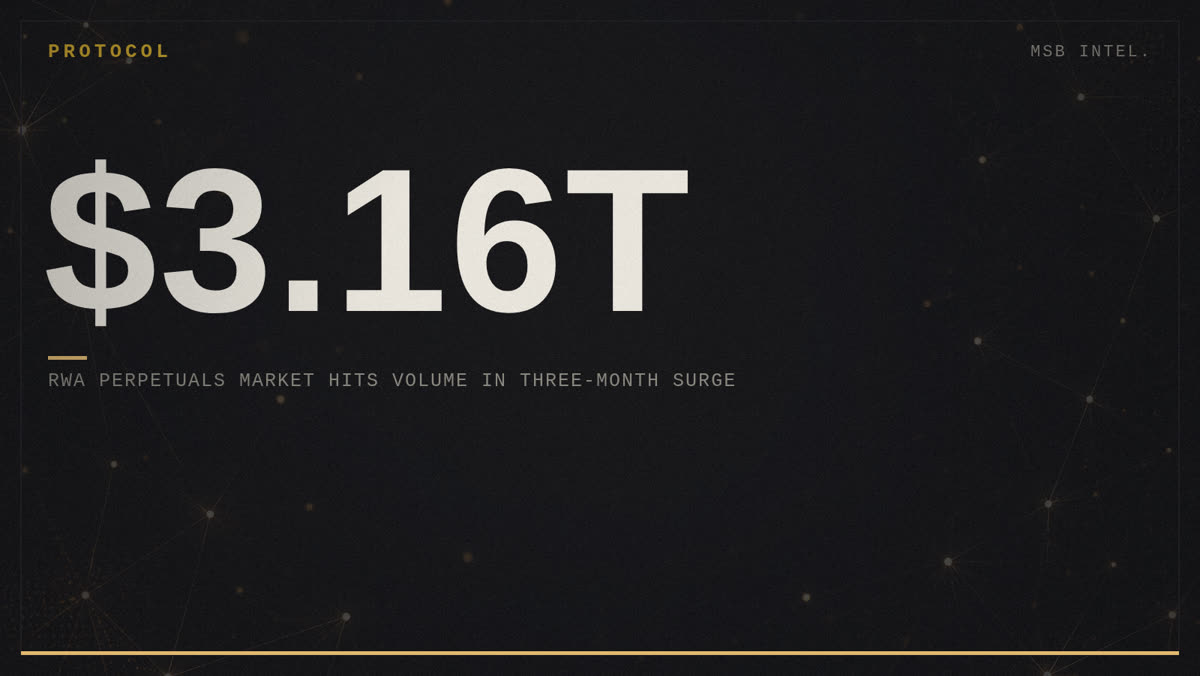
Real-world asset perpetuals trading jumped to $3.16 trillion in cumulative volume across centralized and decentralized exchanges by August 2026, a 285 percent increase from $822 billion in May, according to CoinMarketCap data.
The market's rapid expansion has concentrated sharply among four platforms. Binance, Hyperliquid, OKX and Bitget command 86 percent of the market, with Binance alone accounting for 50.4 percent, Hyperliquid 17.2 percent, OKX 10.9 percent and Bitget 7.5 percent. The four-platform concentration reflects winner-take-most dynamics in derivatives trading, where liquidity clustering and order-book depth typically favor the largest venues.
Stock perpetuals dominate the RWA derivatives market, representing 62.3 percent of August trading volume. Commodity, currency and index perpetuals make up the remainder. Participants use crypto derivatives as an alternative settlement layer for traditional asset exposure rather than diversifying across multiple asset classes.

Binance Chief Executive Changpeng Zhao said in a recent post that on-chain equities initial public offerings could be forthcoming. If public companies begin conducting primary offerings on blockchain infrastructure, the stock perpetuals market would gain an additional capital formation use case beyond speculation and hedging. Such a development would extend the addressable market for the four dominant platforms and validate their role as core trading infrastructure for tokenized securities.
Monthly trading volumes have set new highs consecutively. The three-month growth rate of 285 percent exceeds typical derivatives market expansion in traditional finance, where quarterly volume growth rarely surpasses mid-single-digit percentages. The four platforms captured roughly $2.7 trillion of the $3.16 trillion total volume, a concentration ratio rarely seen outside monopoly or duopoly derivatives markets.
If on-chain equity IPOs materialize at scale, the platforms holding the largest market share would capture outsized fee revenue from both primary issuance and secondary trading. The number to watch is whether any major listed company files documentation for an on-chain offering within the next twelve months, as that would demonstrate whether Zhao's comment reflects near-term operational reality or aspirational positioning.