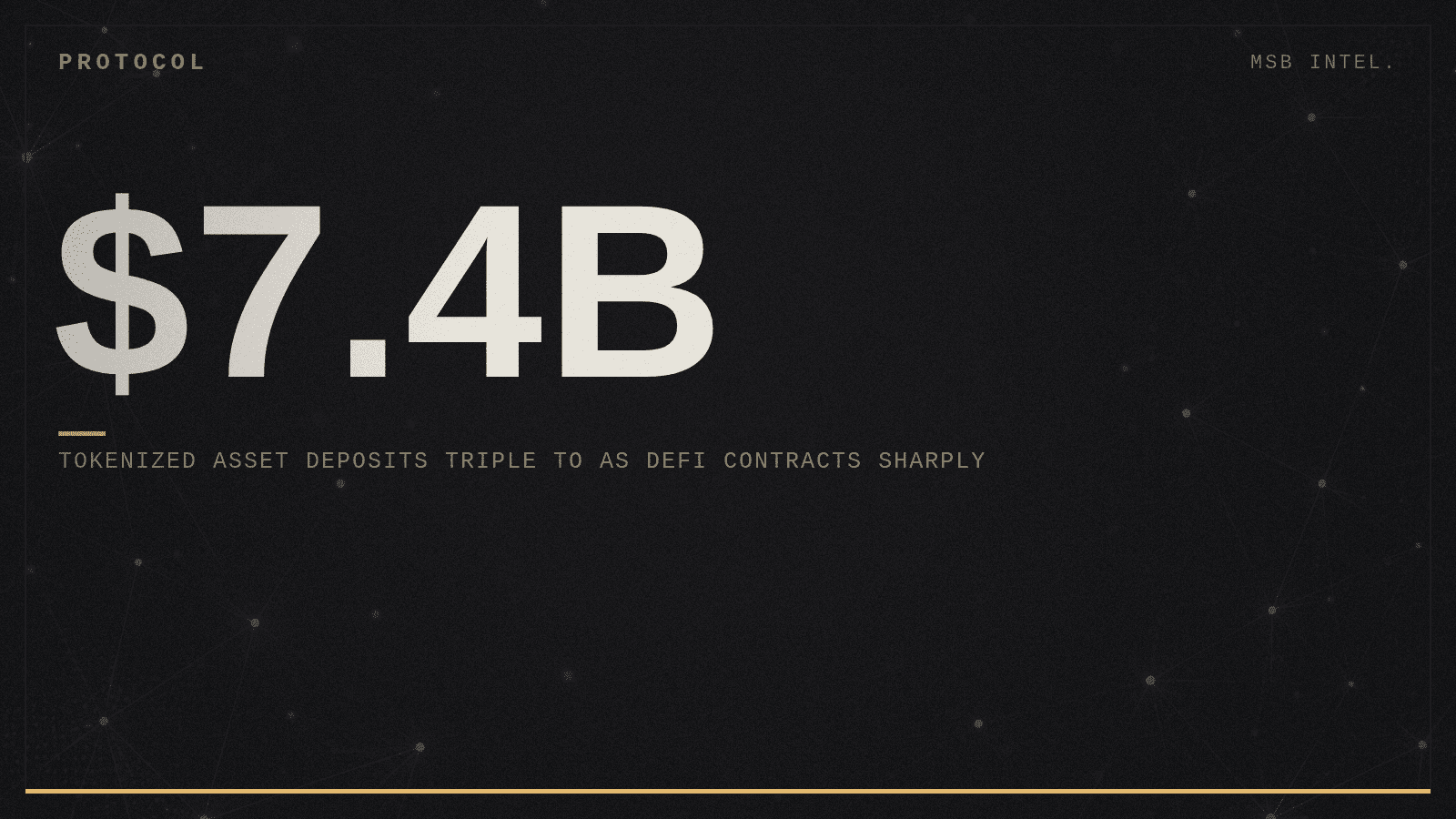
Tokenized asset deposits surged to $7.4 billion in the second quarter of 2026, tripling from $2.3 billion a year earlier, according to a joint report by CoinShares and Token Terminal published August 6. The growth came as traditional decentralized finance declined 15 percent over the same period.
Tokenized treasuries, gold and equities now account for the fastest-growing segment of on-chain capital, while yield-farming protocols and lending platforms that defined the previous cycle continue to contract.
CoinShares and Token Terminal track deposits across platforms offering blockchain-native versions of traditional financial instruments. The $7.4 billion figure encompasses all tokenized assets, equities, fixed-income securities, commodities and derivatives, held in custodial and non-custodial protocols. The category did not exist as a material market in 2023; the first major platforms launched in late 2024 and reached $2.3 billion in deposits by the second quarter of 2025.
The 15 percent contraction in DeFi deposits occurred as Ethereum's ecosystem weakened after the 2023-2024 bull run. Aave, Compound and other leading lending protocols saw outflows as institutional capital migrated toward tokenized bond markets and spot commodity contracts, which offer regulatory clarity and direct exposure to Treasury yields without algorithmic risk.

Asset tokenization has attracted backing from traditional financial institutions seeking exposure to blockchain rails without abandonment of established counterparties. Major custody providers including Coinbase and BNY Mellon launched tokenization arms in 2025 and 2026, competing with crypto-native firms like Ondo Finance and Pendle Finance for deposits.
The gap between tokenized asset growth and DeFi contraction now stands at a 20-percentage-point spread over the year, with tokenized deposits expanding at a 200 percent annualized pace while traditional DeFi protocols lose users to staking, spot trading and centralized platforms.
Institutional investors cited regulatory approval of spot Bitcoin and Ethereum exchange-traded funds as grounds that on-chain markets could absorb trillions in traditional finance. Capital is now flowing to tokenized treasuries and commodities at scale rather than returning to yield protocols whose revenue models depend on speculation.