Spark's stablecoin foreign exchange layer has recorded over $8 billion in pool activity since launching on Uniswap v4, according to an announcement from the protocol.
The layer launched with two trading pairs: USDS/USDT and PYUSD/USDS. Pool activity reached approximately $4.7 billion in the second month following launch, compared with $3.33 billion in the first month, Spark said. The protocol plans to expand the FX layer to additional pairs.
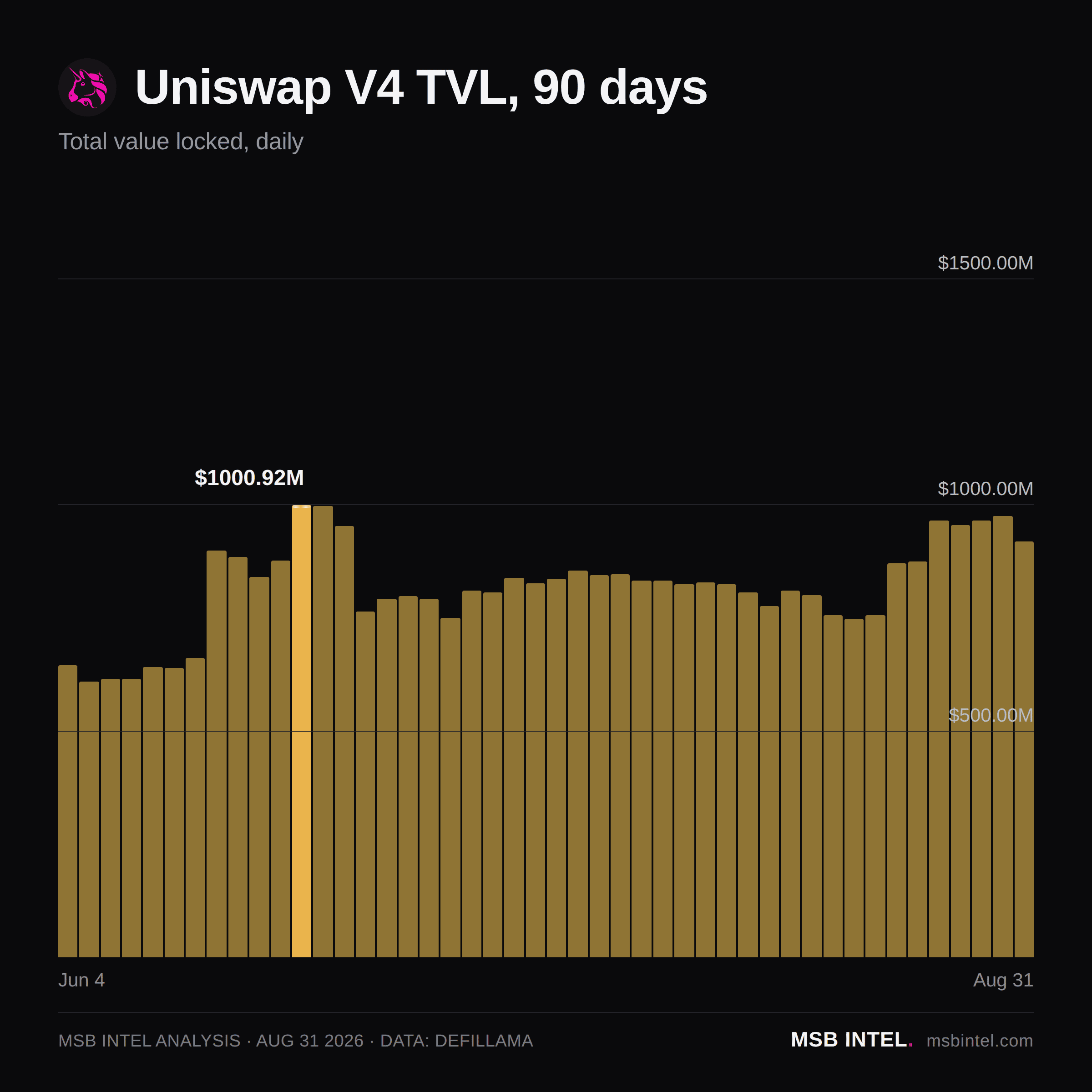
Spark built the FX layer as a liquidity venue for stablecoin trading on Uniswap v4, Ethereum's latest automated market maker release. Uniswap v4 introduced customizable hooks that allow developers to embed specialized logic into pools. Spark's implementation uses this mechanism to optimize execution for stablecoin pairs that typically trade within tight ranges.

The two initial pairs represent major stablecoin combinations. USDS is Spark's native stablecoin, backed by tokenized U.S. Treasury securities. PYUSD is PayPal's dollar stablecoin. USDT remains the largest stablecoin by market capitalization. The USDS/USDT pair provides a direct on-chain bridge between Spark's token and the most-traded stablecoin.
Stablecoin trading volume on decentralized exchanges has increased as institutions seek on-chain settlement for dollar transactions. Uniswap v4 launched in June 2024 and opened permissionless hook deployment in August, lowering barriers for custom liquidity strategies. Spark's FX layer arrived as one of the first production deployments using v4 hooks at scale.
Pool activity grew 41 percent from month one to month two. Spark has not disclosed which pairs will come next or a timeline for expansion. The protocol remains in active development; the FX layer itself launched as a live product rather than a testnet.
If Spark does not announce additional stablecoin pairs within the next 90 days, the rate of growth relative to the first two months will clarify whether the FX layer expands beyond its current footprint.