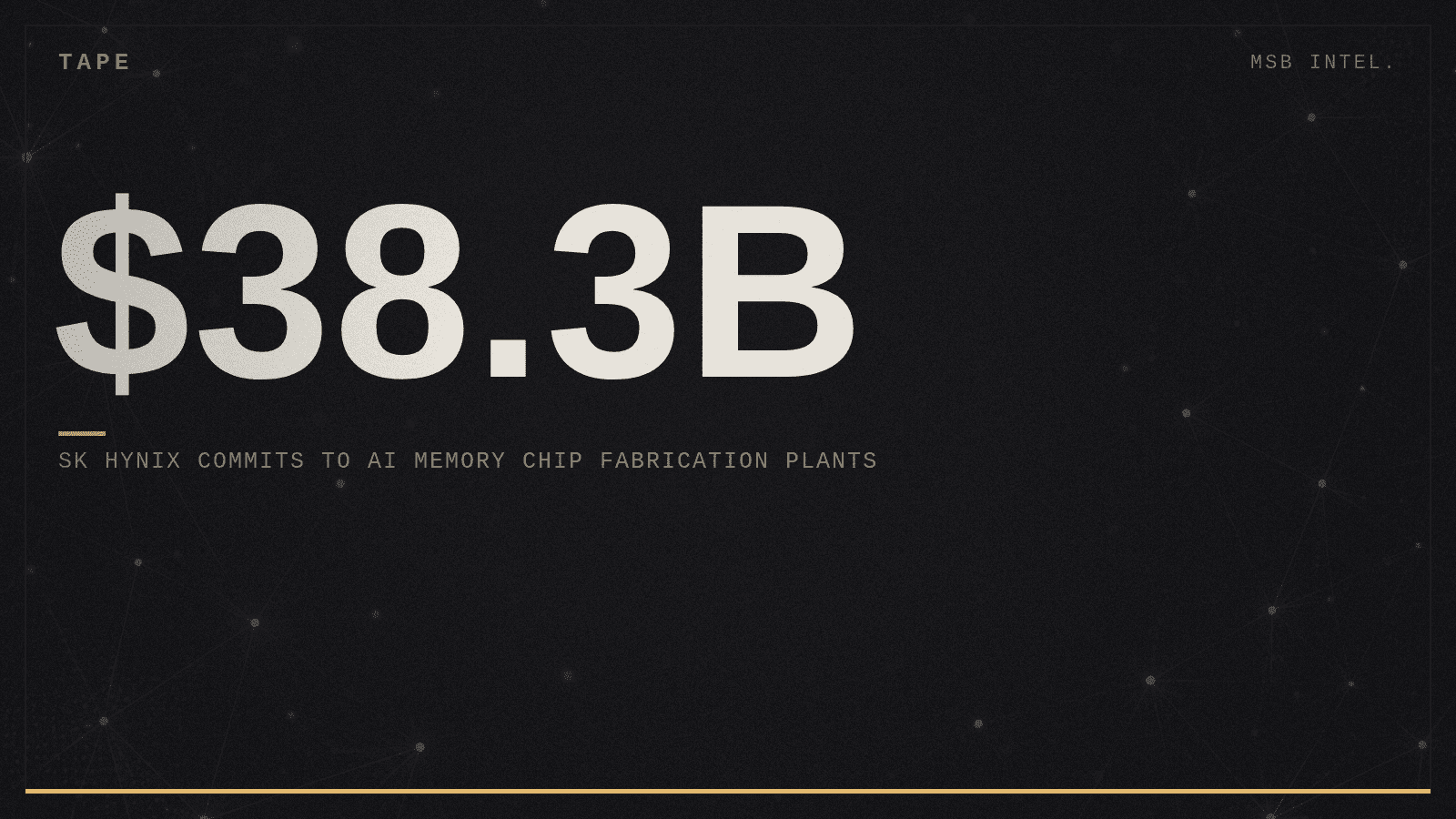
SK Hynix said Friday it will invest 54.3 trillion won, equivalent to $38.3 billion, to build new semiconductor fabrication plants through 2031 in response to surging demand for artificial intelligence memory chips. The South Korean chipmaker's board approved the investment on August 7.
The capital expenditure plan spans two facilities: a Y2 fab in Yongin and an M17 fab in Cheongju. SK Hynix did not disclose the specific allocation between the two plants, but the timeline is consistent with the company's assumption that AI-driven memory demand will sustain high capacity needs over the next five years. The industry has faced cyclical capex cuts before; SK Hynix's 2022 capex fell to $6.7 billion from $8.9 billion the prior year as memory chip prices collapsed.
Memory chip makers have lifted capital spending significantly since 2023 as data centers and AI model training consumed record volumes of high-bandwidth memory and DRAM. Samsung and Micron Technology both expanded capex in 2024 and 2025 in response to the same trend. SK Hynix ranks third globally in DRAM and third in NAND flash production by capacity, behind Samsung and Intel in the former and Samsung and Kioxia in the latter.
The company competes directly with Samsung Electronics, which announced 8.6 trillion won in chip-related capex for 2024, though that figure covered a broader portfolio. TSMC, the leading foundry, invested $28.7 billion in 2024 alone. SK Hynix's multi-year commitment of $38.3 billion averages $7.66 billion annually, placing it in line with peers' recent run rates but below Samsung's and TSMC's peak spending.
AI chip demand has tightened memory supply. Nvidia's H100 and H200 GPUs consume significant quantities of HBM, a specialized memory format that commands premium pricing. SK Hynix holds roughly 30 percent of the global HBM market, according to industry analysts, competing against Samsung. The company has also begun mass production of its own HBM4 specification in 2025.
South Korea's semiconductor sector has remained central to the country's export economy. The government has offered subsidies and tax incentives to keep foundry and memory capacity domestic. This investment arrives as the broader industry contends with sustained geopolitical pressure: U.S. export restrictions on advanced chip sales to China have diverted some demand to secondary markets and created inventory uncertainty.
SK Hynix's $38.3 billion commitment represents a 4.3x increase over its 2022 capex floor. The company will face execution risk on timeline and cost overruns; semiconductor fab construction routinely exceeds initial budgets and timelines.
The financial performance of these fabs depends on whether memory pricing remains high or reverts to historical lows. If SK Hynix completes M17 and Y2 as planned by 2031 and achieves target output rates, the company expects to compete for share in both HBM and commodity DRAM markets. The number that decides it is whether SK Hynix's revenue per wafer justifies the capex by 2033, or whether memory oversupply returns.