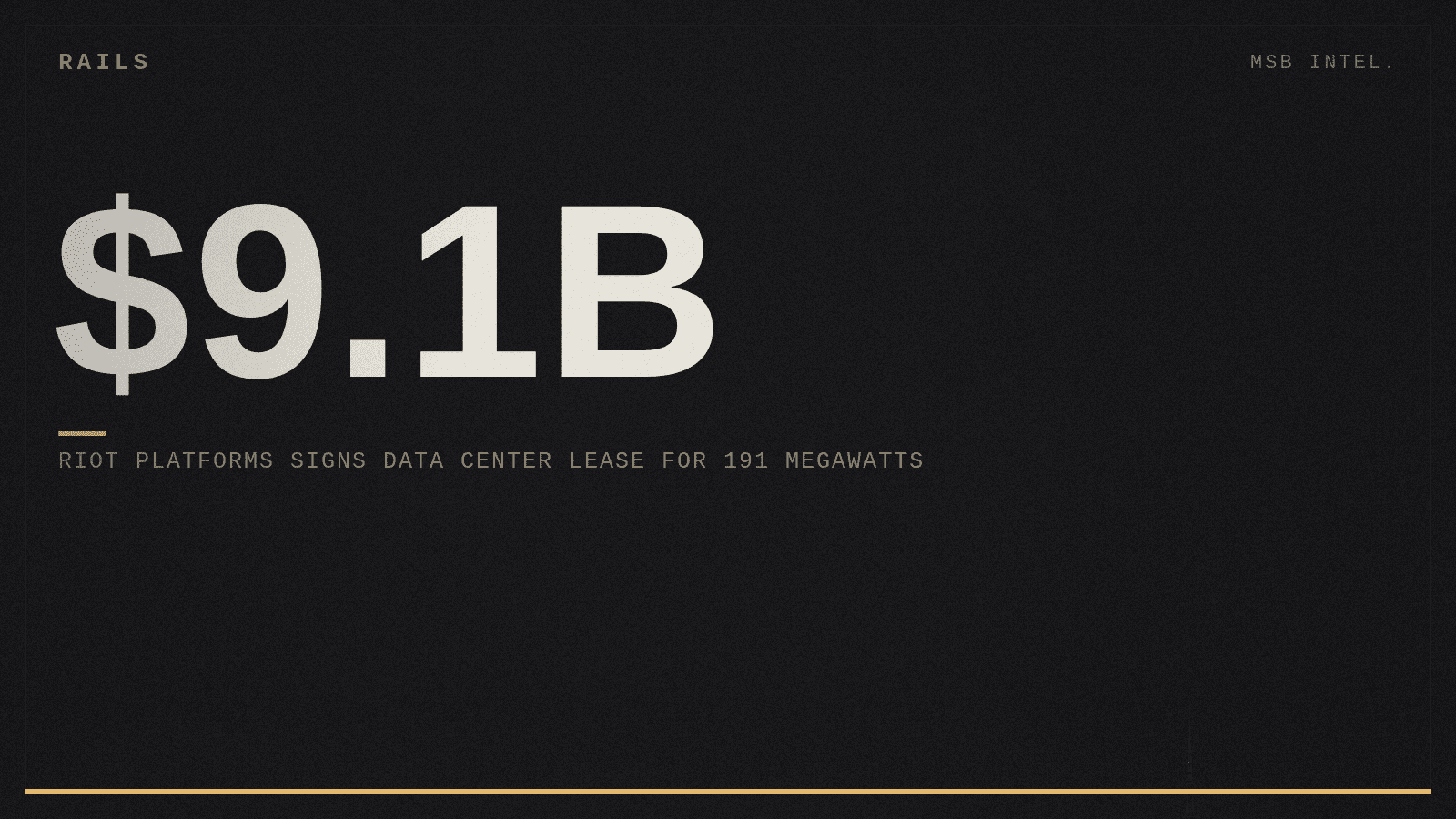
Riot Platforms signed a 20-year lease with a frontier artificial intelligence lab to deploy 191 megawatts of compute capacity at its Rockdale, Texas campus, according to the company's second-quarter earnings announcement. The contract is expected to generate $9.1 billion in revenue over its term.
The deal represents a pivot for Riot, which has built itself as a bitcoin miner since its 2017 founding. The Rockdale facility, which Riot operates on a former coal plant site outside Austin, now doubles as infrastructure for AI model training. The lease terms place Riot in competition with data center operators and power providers bidding to supply the surging electrical demands of large language model development.
Riot reported second-quarter revenue of $174.2 million, beating analyst estimates. The company posted an adjusted EBITDA loss of $69.7 million for the period. Riot holds 11,380 bitcoin on its balance sheet. Stock traded up 11 percent after hours on the announcement.
The AI data center segment has drawn major capital commitments this year as training labs race to secure power-constrained sites. Microsoft, Google and other cloud providers have negotiated multi-gigawatt capacity agreements with utilities and independent operators. Riot's Rockdale lease with an unnamed AI lab differs from those arrangements in that Riot is leasing capacity rather than purchasing it; the company keeps ownership of the facility and collects rent from the counterparty.
Riot did not name the AI lab in its filing. The company also did not disclose the per-megawatt or per-unit pricing in the arrangement, leaving the effective rate per MW per year at $9.1 billion divided by 20 years divided by 191 megawatts, or roughly $2.38 million per megawatt annually.
The Rockdale deal comes as Riot has reduced its bitcoin mining fleet. The company operated approximately 35 exahashes of computing power as of June 30, down from prior quarters as the firm reallocated power capacity to the data center lease. Bitcoin mining remains part of Riot's operations but is no longer its sole revenue driver.
The lease's 20-year duration is typical for infrastructure agreements with AI labs, which require long-term certainty on power supply to justify training pipeline investments. The contract's revenue is material to Riot's current scale: $9.1 billion over 20 years equals $455 million annually, or 2.6 times Riot's Q2 annualized revenue run rate at $174.2 million. The deal's structure passes power cost volatility and operational risk to Riot rather than spreading it across both parties, a common trade-off that higher-margin operators accept to secure multi-year commitments.
Riot did not disclose the AI lab's identity. If Riot does not name the lab by the time it files its next 10-Q, the lab's counterparty status may indicate either a non-disclosure agreement or uncertainty about the deal's final close.