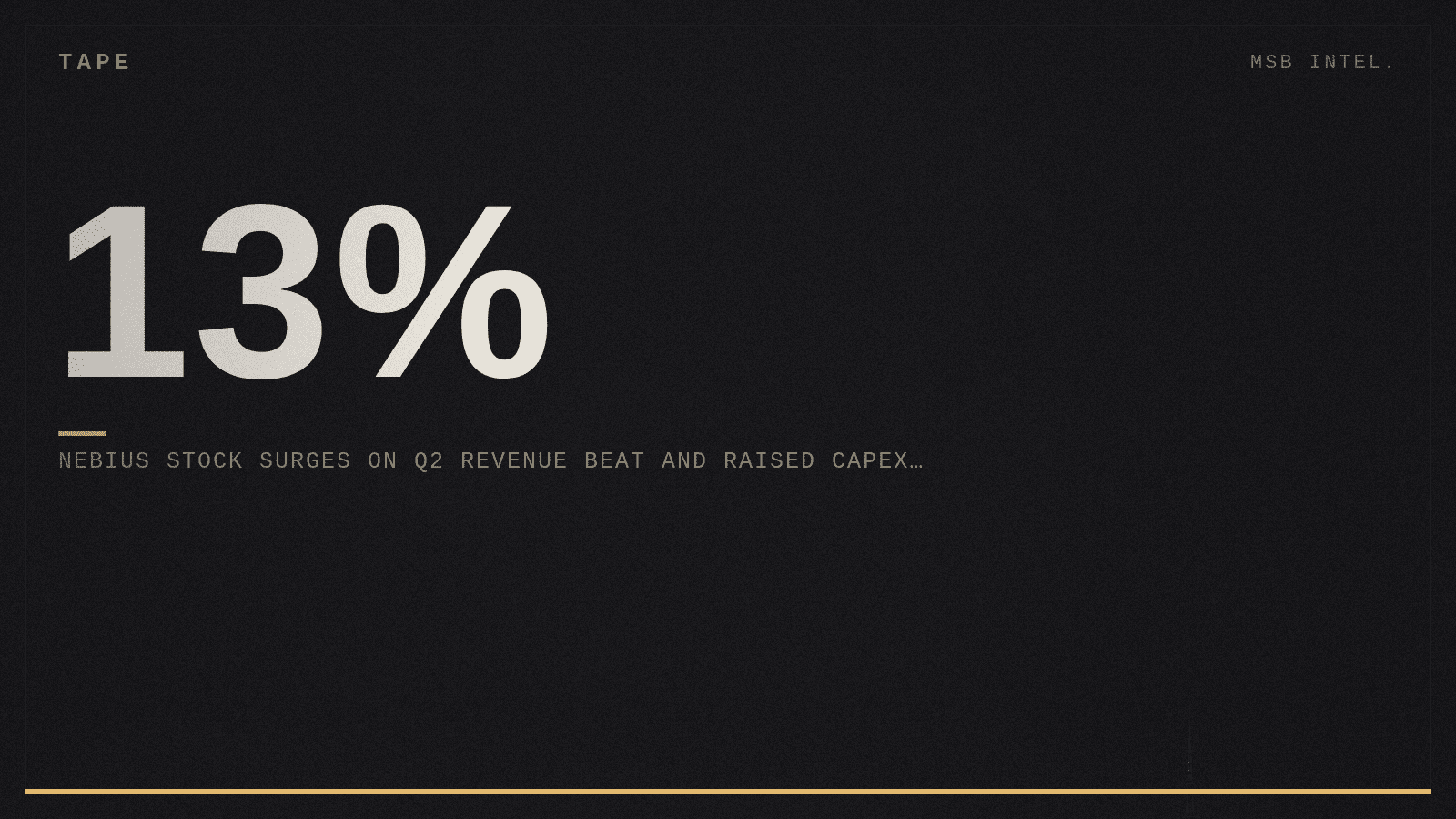
Nebius reported second-quarter revenue of $582.3 million, beating analyst consensus of roughly $573 million, and raised its full-year capital expenditure guidance to $25 billion from a prior range of $16 billion to $20 billion. The stock surged 13 percent in after-hours trading following the earnings announcement on August 12.
Revenue grew 454 percent year-over-year in the quarter. The company reaffirmed its full-year 2026 revenue guidance of $3 billion to $3.4 billion. The capex raise follows accelerating demand for artificial-intelligence and high-performance computing services.
Nebius is a cloud infrastructure provider focused on AI workloads and serves customers in generative AI training and inference. The company has positioned itself to capture demand from both startups and enterprises building AI systems outside major cloud providers' ecosystems. The $25 billion capex target over the full year commits the company to data center buildout and GPU procurement at a time when infrastructure for AI remains a bottleneck globally.
The capex guidance raise comes as the broader infrastructure-for-AI sector faces intense capital requirements. Competitors including CoreWeave and Lambda Labs have also announced large expansion plans. Nebius is raising spending guidance in an environment of tight GPU supply and high hardware costs.

Nebius's 454 percent year-over-year growth rate exceeds most software and cloud infrastructure peers, though the company remains substantially smaller by revenue than established hyperscalers.
The capex figure is now nearly three times Nebius's annualized Q2 revenue run rate, a ratio that shows the company is operating in investment mode rather than cash generation. The guidance raise narrows the company's capex range from $16 billion-$20 billion to a single target of $25 billion, removing ambiguity on spending plans through the remainder of the year.
The metric to watch is whether Nebius achieves its reaffirmed $3 billion-$3.4 billion full-year revenue guidance when it reports Q3 and Q4 results, and whether the $25 billion capex is deployed as stated or subject to further revision based on hardware availability and customer demand.