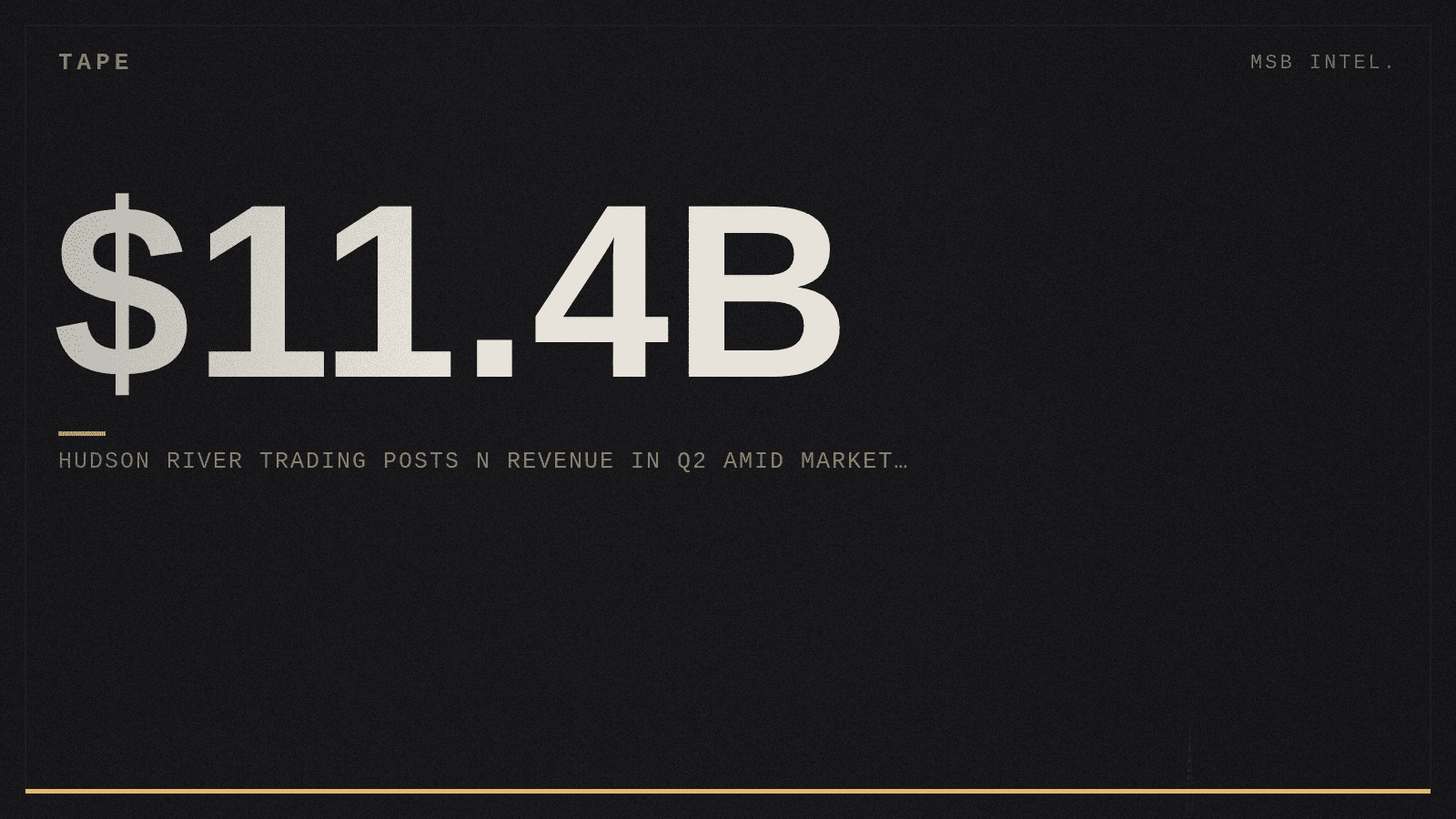
Hudson River Trading reported $11.4 billion in trading revenue for the second quarter of 2026, the firm's largest quarterly haul on record, according to a Bloomberg report published August 19, 2026. The Wall Street trading shop capitalized on volatility across AI equities and geopolitical turbulence tied to Iran escalation in July.
The scale of the figure shows how principal trading firms profit from the exact conditions that unsettle broader markets. Hudson River's trading book benefits when price discovery widens; the firm's algorithms exploit the gaps between spot moves and where institutional buyers and sellers meet. A $11.4 billion quarterly revenue run annualizes to $45.6 billion, a figure that dwarfs most bank trading divisions and positions Hudson River among the highest revenue financial firms on earth.
Markets in July experienced acute dislocations. AI stocks, which had rallied hard into mid summer, suffered sharp reversals as tensions between Israel and Iran escalated, triggering safe haven flows and sector rotation. Equity index futures widened their bid ask spreads. Volatility indexes spiked. High frequency and algorithmic traders extract the most value when dislocations between spot and derivative prices are widest; the longer the dislocation persists, the more revenue flows to firms with capital and latency advantages.

Hudson River has built its business on precisely this edge. Founded in 2003, the firm operates as a principal trader across equities, options, commodities and fixed income, running capital against its own book rather than taking commissions. The company does not disclose balance sheet size, but trades in volumes that place it among the largest liquidity providers on U.S. exchanges. Its previous record quarters occurred in periods of acute market stress: the 2015 August selloff, parts of 2020, and the 2023 bond market repricing all produced outsized trading revenue for the firm.
The Q2 2026 result comes as volatility has receded from July peaks. The firm's third quarter results, if reported, will test whether the July windfall was a temporary spike or the start of a sustained higher volatility regime. Broader equity markets have stabilized, and AI stock drawdowns have been partially retraced. If volatility subsides into the fourth quarter and geopolitical risk premiums deflate, Hudson River's trading revenue would be expected to contract from the Q2 peak.
Hudson River's Q2 haul represents approximately 0.024 percent of total U.S. equity market trading volume, though the firm's actual profit margin on that revenue remains undisclosed. The comparable figure for Q1 2026 was not made public, so the size of the sequential increase cannot be computed from available data.