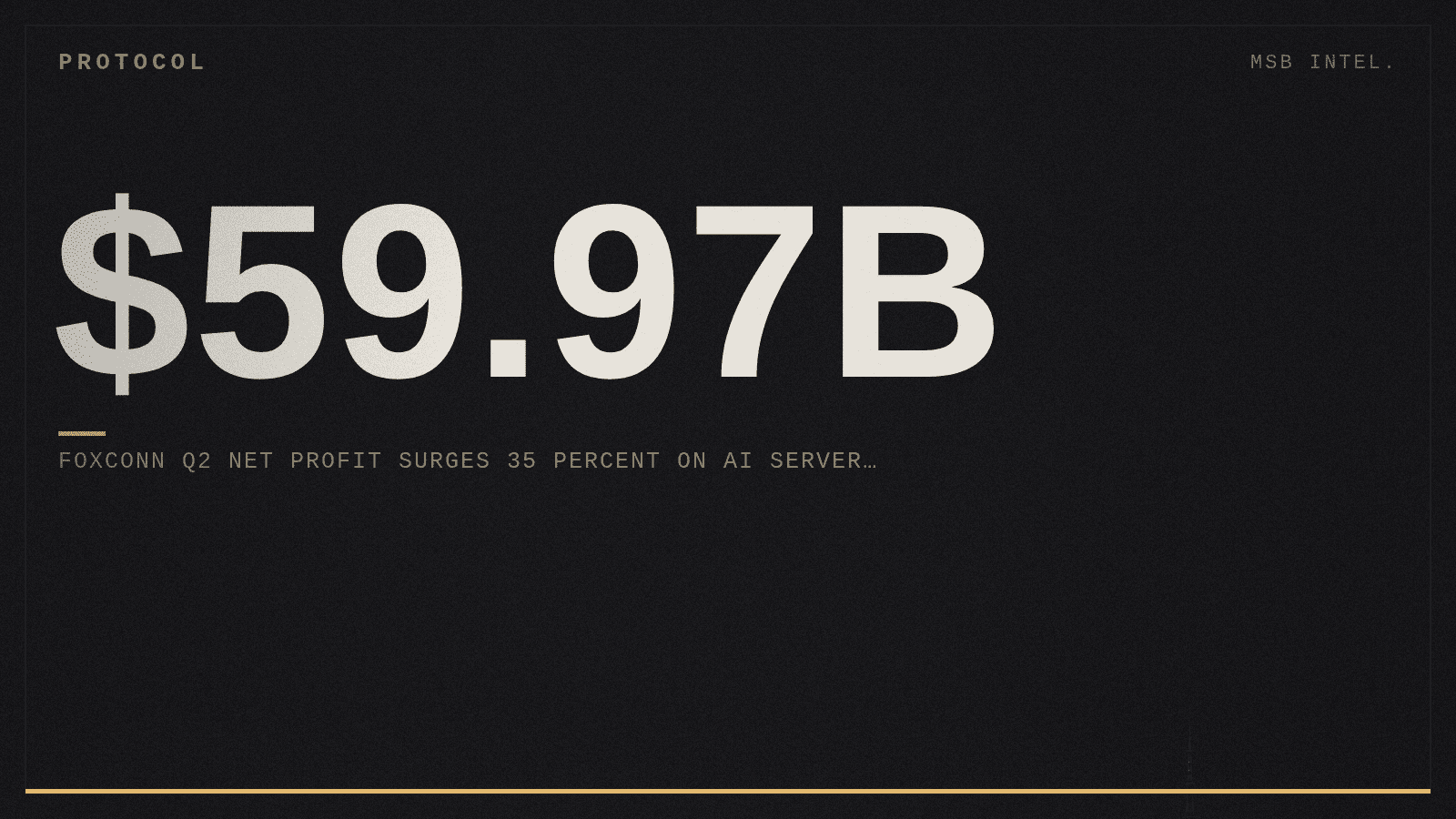
Foxconn's second-quarter net profit jumped 35 percent year-over-year to NT$59.97 billion, the Taiwan-based electronics manufacturer said in an announcement Tuesday, citing strong demand for artificial intelligence servers as the primary driver of the gain.
The profit figure compares to NT$44.4 billion in the same quarter last year. Foxconn, which manufactures hardware for Apple, Meta, and other major technology companies, maintained its growth outlook for the remainder of 2026 amid continued AI infrastructure buildout by major cloud providers and chipmakers ramping production capacity.
Foxconn is the world's largest contract electronics manufacturer by revenue and employs over one million workers across facilities in Taiwan, mainland China, Vietnam, and Mexico. Major cloud providers including Amazon, Microsoft, and Google have announced hundreds of billions in capital expenditure on data center expansion and AI chip production over the next three to five years.
The company's profit growth rate of 35 percent year-over-year exceeds the broader Taiwan stock market's performance in the same period, where the weighted index rose approximately 8 percent in the first half of 2026. Foxconn's exposure to AI infrastructure demand has positioned it as a primary beneficiary of the spending wave, even as consumer electronics manufacturing, historically a larger revenue driver for the firm, faces headwinds from softening smartphone and personal computer demand.
Foxconn did not specify what percentage of Q2 revenue came from AI server orders versus traditional consumer hardware manufacturing. The company has announced plans to open new manufacturing facilities in India and expand capacity in Vietnam, moves designed to diversify away from mainland China production amid U.S.-China trade tensions. Taiwan's government has designated advanced semiconductor and electronics manufacturing as a strategic priority, offering tax incentives and low-interest financing to firms that expand domestic and allied-nation production.
The company's maintained growth guidance for the full year contrasts with more cautious outlooks from some competing contract manufacturers, who cited inventory corrections and softer demand outside the AI sector. Foxconn's reliance on orders from U.S.-listed tech giants means exchange rate fluctuations, the Taiwan dollar has strengthened roughly 4 percent against the U.S. dollar since January, could compress profit margins in future quarters even if revenue volumes hold steady.
Foxconn's ability to sustain 35 percent profit growth into the second half depends on whether major customers' AI capex spending continues at current levels or accelerates further, a question complicated by unproven demand for many AI use cases beyond large language model training. The company's next earnings call is expected in late October.