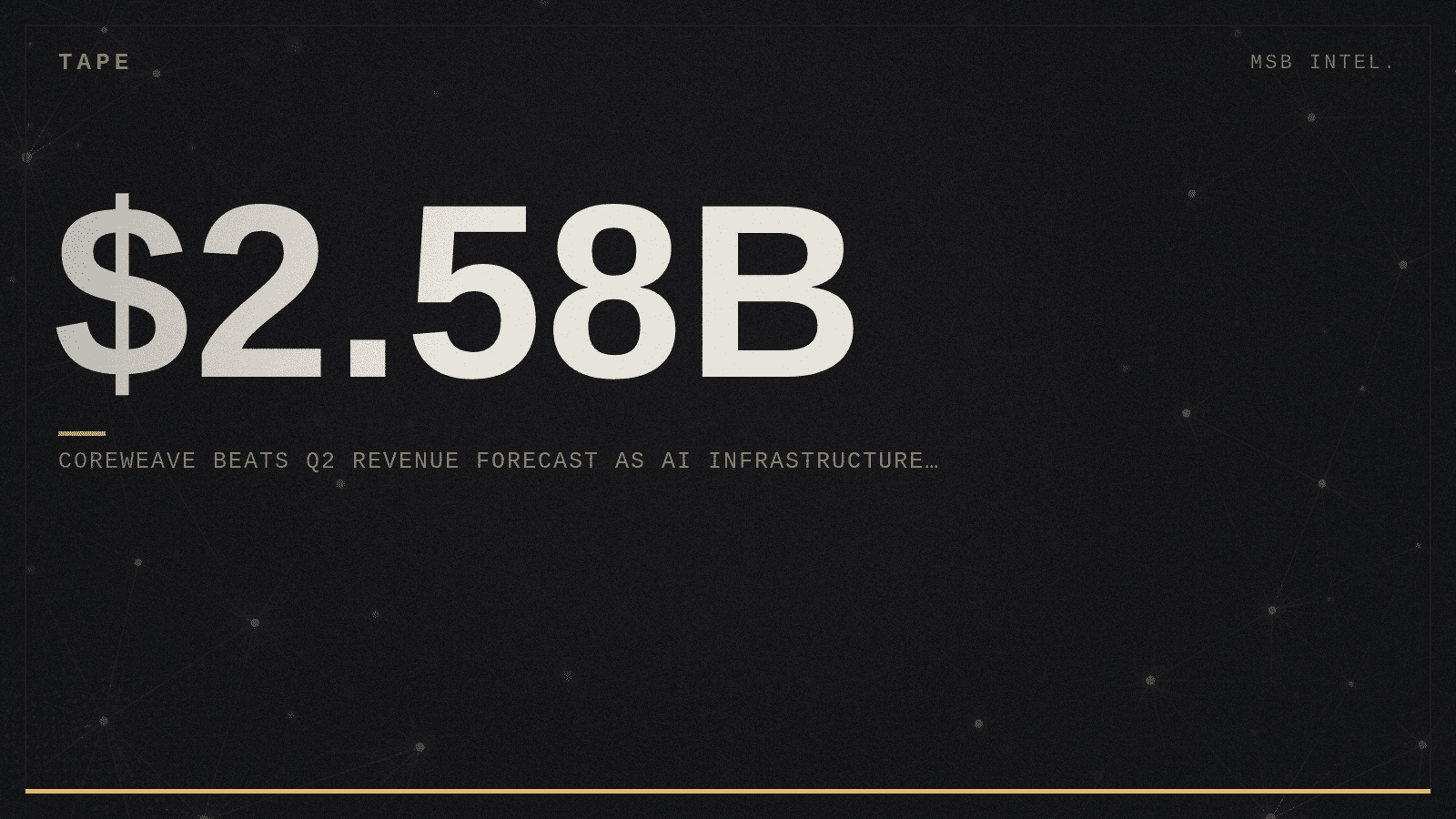
CoreWeave reported second-quarter revenue of $2.58 billion, topping analyst expectations of $2.56 billion, as demand for AI infrastructure rental capacity remained strong. The beat coincided with Super Micro Computer raising its fiscal 2027 first-quarter guidance to a $15 billion midpoint, well above the roughly $12 billion consensus, sending both stocks higher and lifting equity markets across Asia on August 12.
CoreWeave operates data centers leased to AI model developers and inference companies. Its $2.58 billion quarter represents a narrowly beaten forecast, but the company's willingness to raise full-year guidance came at a moment when GPU scarcity has begun to ease and larger cloud operators including Amazon and Google have ramped internal AI chip production.
The earnings report showed the company's AI infrastructure rental business operating at full capacity. CoreWeave's marginal beat reflects the continued intensity of demand from generative AI model makers who continue to prioritize access to NVIDIA H100 and H200 GPUs over build-out timelines and unit economics. The company has expanded its footprint from 12 facilities in 2024 to over 30 as of mid-2026.
Super Micro's forward guidance raise carried outsized weight. The server manufacturer issued Q1 fiscal 2027 guidance of $15 billion at the midpoint, up from consensus estimates near $12 billion. That gap represents a 25 percent raise relative to consensus expectations. Super Micro builds custom servers optimized for AI workloads, and its forecast embeds supplier confidence that AI capex cycles will persist through the first half of next year without material pullback.
The dual beat triggered broad equity strength in Asia. South Korea's KOSPI index rose 4 percent on August 12, while Japan's Nikkei advanced 0.6 percent. The moves reflected appetite for exposure to AI infrastructure and semiconductor suppliers on revised earnings trajectories. US equity-index futures also advanced on the data.
Both companies have benefited from sustained corporate spending on large language model development. OpenAI, Anthropic, and other frontier labs remain capital-constrained by chip availability rather than budget. That constraint has persisted longer than many investors expected in late 2024, when GPU supply was projected to ease by mid-2025. CoreWeave and Super Micro's beats show the tightness extends at least into late 2026.
CoreWeave's beat margin of $20 million against a $2.56 billion forecast equals 0.78 percent. Super Micro's guidance raise from $12 billion to $15 billion represents a 25 percent revision to consensus in a single quarter, a magnitude that typically occurs only when demand patterns shift durably rather than when a single supplier outperforms.
The inflection point to watch is whether corporate AI capex stabilizes or declines in 2027. If Super Micro's $15 billion Q1 forecast holds and guidance for subsequent quarters remains above $12 billion through fiscal 2027, demand for infrastructure has persisted as more than a temporary peak. If guidance retreats in the next two quarters, the sell-side consensus reset will reverse.