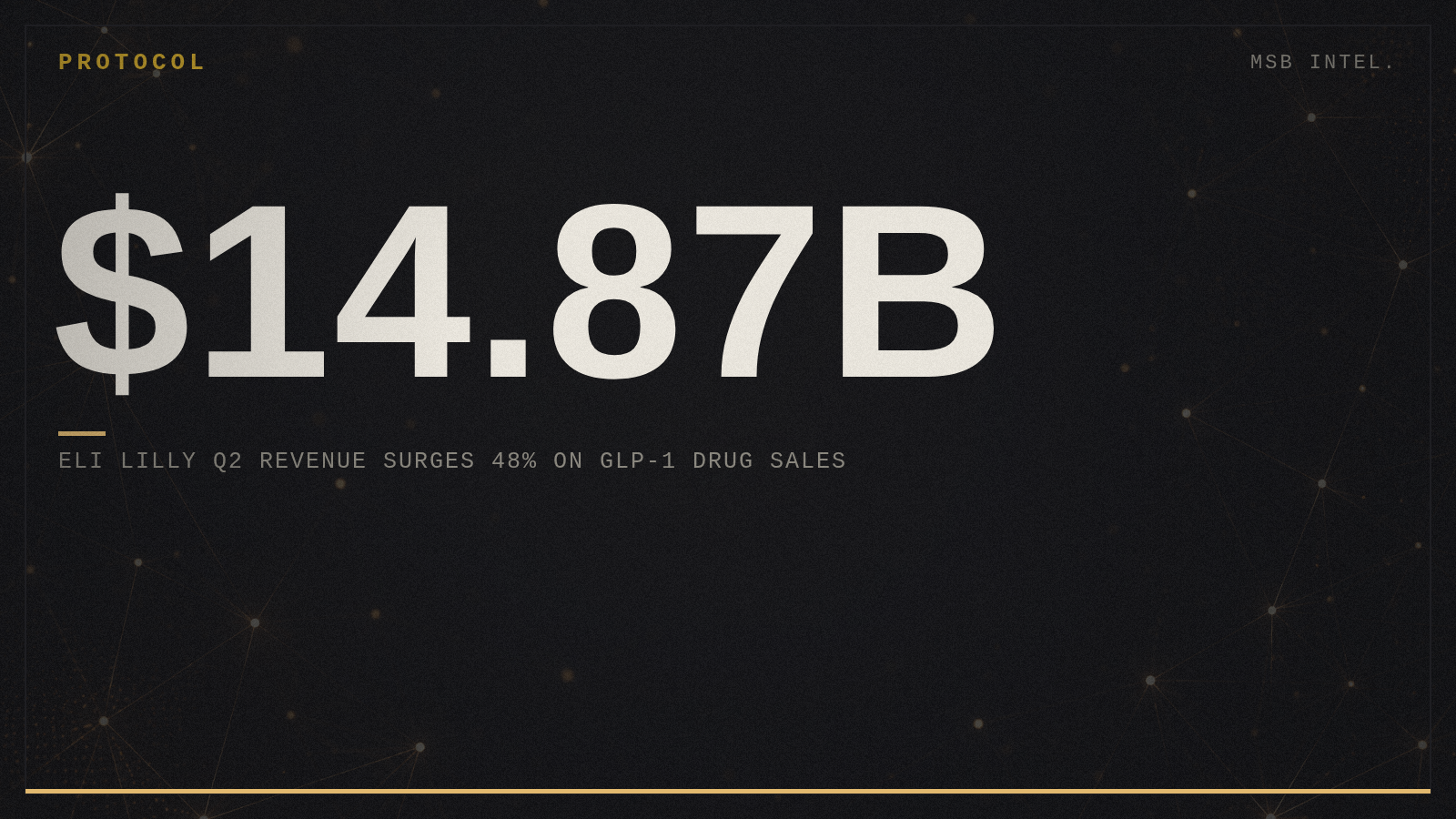
Eli Lilly reported second-quarter revenue of $23 billion, up 48% year-over-year, driven by combined sales of $14.87 billion from its two tirzepatide-based weight-loss drugs, Mounjaro and Zepbound, according to the company's earnings announcement.
The two drugs accounted for roughly two-thirds of the company's quarterly revenue. Mounjaro, the diabetes formulation, generated $9.94 billion, a 91% increase, while Zepbound, its weight-loss branded version, brought in $4.93 billion, up 46%. Volume growth across the tirzepatide franchise reached 37%, the company said.
Eli Lilly's tirzepatide franchise has accelerated faster than competitor Novo Nordisk's semaglutide products in the same period. The two-drug combination's Q2 performance came as supply constraints that plagued 2024 and early 2025 have eased. The company raised full-year guidance following the results.
The tirzepatide class remains newer to market than semaglutide, which Novo Nordisk launched first. Mounjaro entered the U.S. in 2022, and Zepbound followed in late 2023. Both faced manufacturing bottlenecks that limited availability in their first years. Eli Lilly has invested in production capacity to meet demand, and volume expanded 37% in the quarter.

Some clinical data has shown tirzepatide outperforms semaglutide on weight loss. The drug class itself, GLP-1 and GIP receptor agonists, created a market that did not exist at scale before 2023, pulling in patients without diabetes seeking weight loss.
Eli Lilly's tirzepatide drugs now represent the fastest-growing segment in large pharmaceutical revenue. The $14.87 billion run rate annualizes to roughly $59 billion, a scale comparable to global blockbuster drugs in their mature phases despite the franchise being in its second full year. Novo Nordisk's semaglutide-based weight-loss drug Wegovy generated $1.3 billion in 2024 and remains supply-constrained in some markets.
The $14.87 billion combined figure assumes the growth rate holds through the full year, which remains contingent on sustained demand, no major safety signals, and continued manufacturing capacity additions. If Eli Lilly sustains this tirzepatide trajectory through 2026, the two drugs will have captured the largest share of the newly expanded GLP-1 market by year-end.