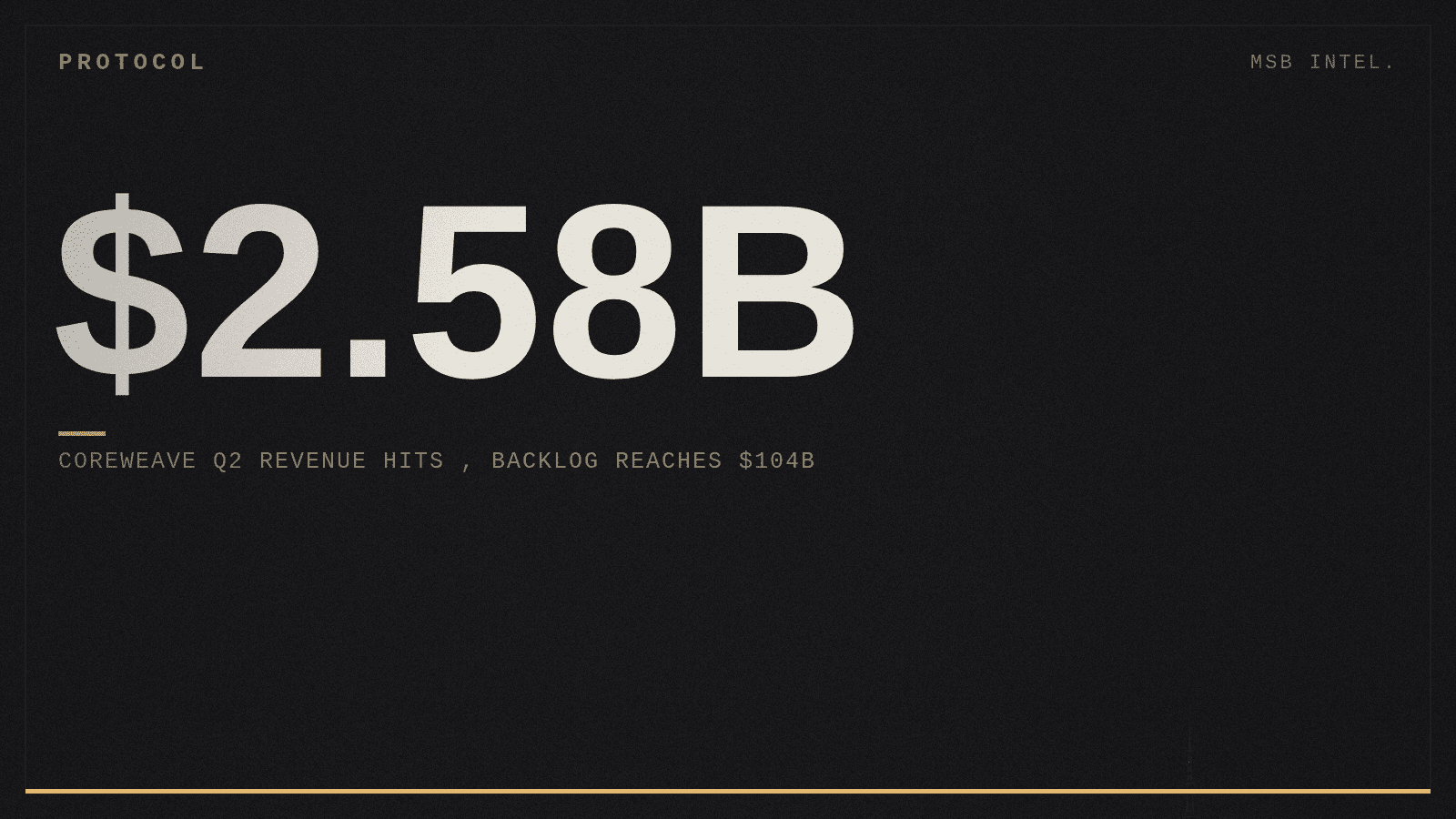
CoreWeave reported second-quarter revenue of $2.58 billion, exceeding analyst consensus of $2.56 billion, while its order backlog surged to $104 billion, according to an 8-K filing dated August 11, 2026.
The GPU infrastructure provider's backlog, orders contracted but not yet fulfilled, now represents over 40 times its quarterly revenue run rate. The figure shows unfilled demand for AI compute capacity as major cloud providers, hyperscalers and enterprise customers lock in long-term server and data center commitments amid a sustained shortage of graphics processors.
CoreWeave has emerged as one of the primary suppliers of specialized compute infrastructure outside the three dominant cloud platforms. The company operates a network of data centers optimized for GPU-intensive workloads, particularly large language model inference and training. Its customer base includes both established cloud providers and newer AI-focused infrastructure operators.
The $104 billion backlog represents contracted revenue expected to be recognized over periods ranging from months to years, depending on deployment timelines and service agreements. Backlog figures do not represent profit but rather the top-line revenue CoreWeave has committed to deliver. At Q2's revenue pace, the company would take roughly 40 quarters to clear the queue if no new orders were added, though revenue is expected to accelerate as data centers come online.

The beat on Q2 revenue, though narrow at $20 million above consensus, comes as the AI infrastructure market has tightened capacity further. CoreWeave and competitors including Lambda Labs and other specialized GPU providers have raised capital aggressively to fund expansion. Earlier in 2026, CoreWeave secured $200 million in Series D funding at a $2.3 billion valuation, according to previous announcements.
The company's revenue has accelerated sharply. Q2's $2.58 billion represents roughly a doubling from comparable figures a year prior, driven by deployment of existing and newly installed capacity. The backlog growth outpaced revenue growth, indicating that customer commitments are accumulating faster than fulfillment.
CoreWeave's position depends on sustained GPU availability and its ability to deploy data centers faster than hyperscalers can absorb AI inference workloads in-house. The $104 billion backlog at current deployment rates would require CoreWeave to roughly triple its revenue pace over the next two years to clear, a trajectory tied directly to supply-chain throughput for processors and real estate availability in major AI infrastructure hubs.