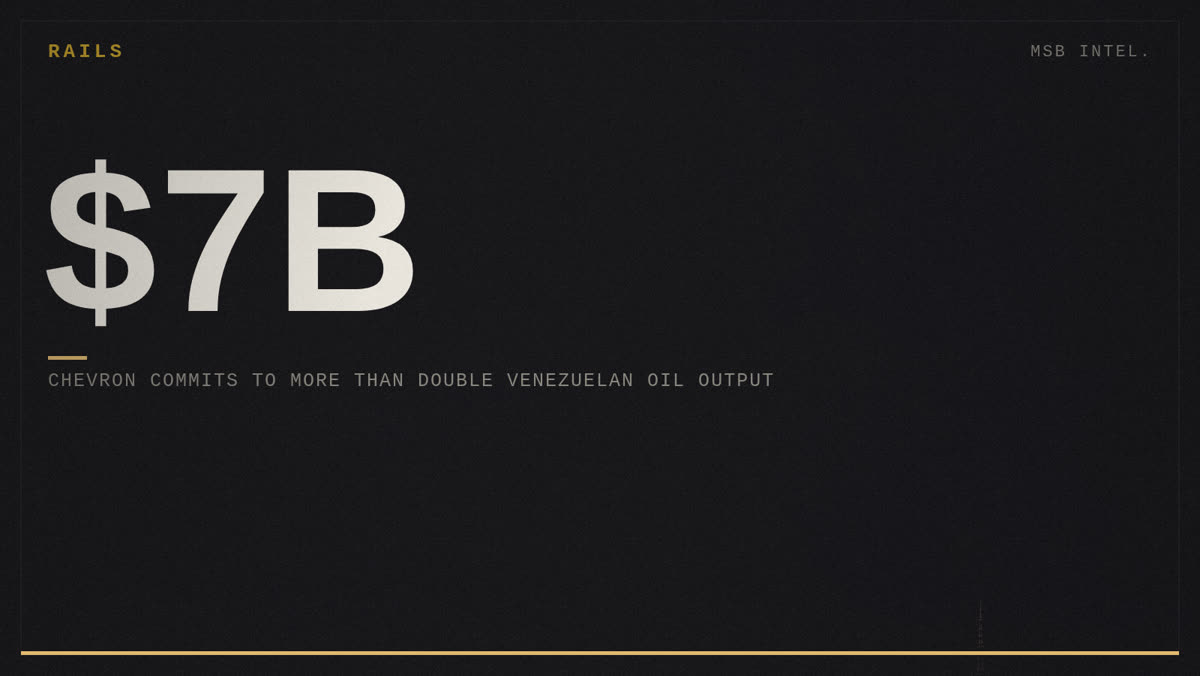
Chevron will invest $7 billion over five years to more than double its oil production in Venezuela, the company announced September 2. The commitment marks Chevron's largest financial deployment in the country to date.
Chevron's current Venezuelan output stands at roughly 280,000 barrels per day. The investment is expected to raise production to approximately 600,000 barrels per day within the five-year window, according to the announcement. The US government has moved to restore Venezuelan oil supply to global markets after years of sanctions and operational collapse under former president Nicolas Maduro.
Venezuela's oil industry has contracted sharply since 2013, when output exceeded 3 million barrels per day. Sanctions imposed by the Trump and Biden administrations from 2017 onward froze most US companies out of the country. The Biden administration began easing restrictions in late 2022 and granted Chevron a license to resume limited operations. Chevron had maintained a small presence through joint ventures with the Venezuelan state oil company Petróleos de Venezuela, S.A., or PDVSA.
The $7 billion figure represents a dramatic escalation from Chevron's prior posture. The company had kept Venezuelan operations minimal, operating under strict license conditions that required reinvestment of profits within the country rather than repatriation to shareholders. Chevron is committing to production capacity that assumes the US policy environment will remain permissive and that Venezuelan production can be brought online at commercial scale.

Production doubling from 280,000 to 600,000 barrels per day would restore Venezuela to a fraction of its historical capacity but would still add material supply to global markets. Venezuela sits atop the world's largest proven oil reserves, estimated at over 300 billion barrels, though much of that crude is heavy and costly to extract. Chevron's investment focuses on conventional fields where extraction economics are more favorable.
Chevron's commitment arrived as the broader energy sector grappled with supply constraints and oil prices at elevated levels. Global crude benchmarks have remained volatile, with geopolitical risk premiums embedded in prices. Venezuelan output restoration could contribute to supply stability, though the timeline extends five years into the future and depends on sustained policy continuity under the Biden administration and any successor.
Chevron's five-year deployment window extends well past the 2024 US presidential election, meaning the investment assumes political durability across administrations. Any reversal of sanctions policy or shift toward stricter Venezuela restrictions would materially impact the project's return on capital. The company has historically operated in Venezuela at the sufferance of US foreign policy, and regulatory risk remains inherent to the investment thesis.
Restoring Venezuelan supply serves multiple policy objectives: bolstering the Maduro government's international legitimacy, reducing American exposure to Middle Eastern oil markets, and testing whether sanctions regimes can shift. Chevron's largest Venezuela commitment in decades now rests on the continuation of that diplomatic trajectory.