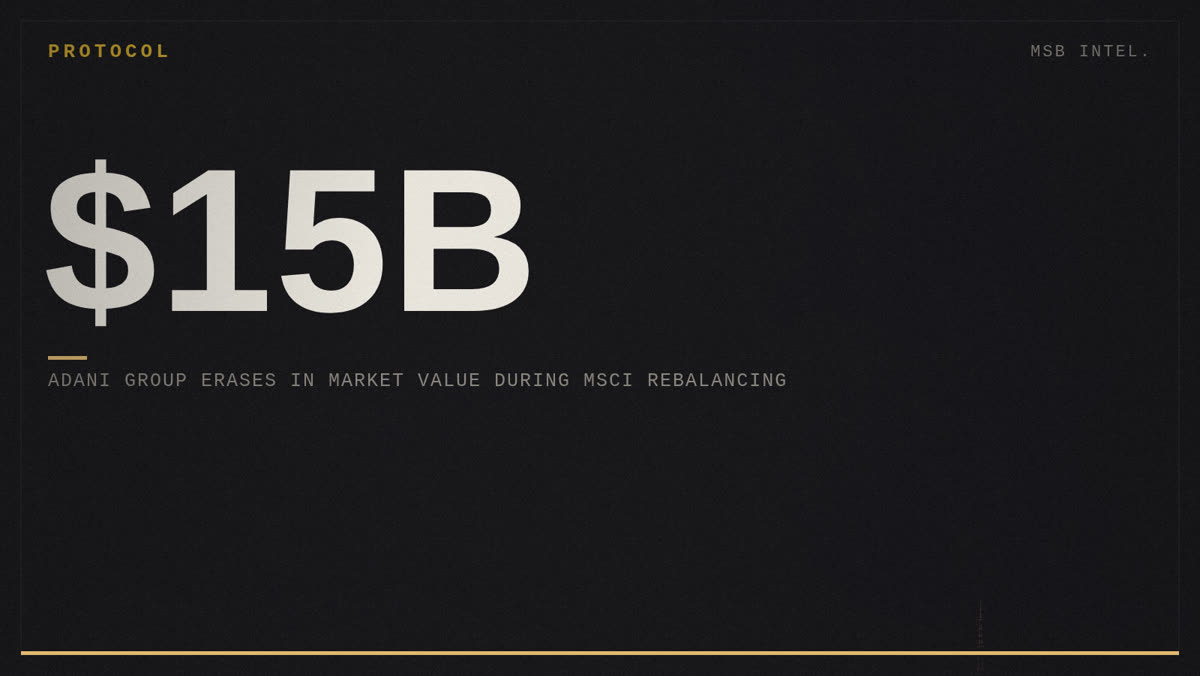
Adani Group companies shed 1.4 trillion rupees, or $15 billion, in market value on Monday, marking the largest single-day decline in approximately 21 months. The sell-off occurred during India's closing auction as MSCI Inc. executed a scheduled index rebalancing.
MSCI rebalancing events can trigger substantial price swings in individual stocks when large passive funds adjust their holdings to match new benchmark weights. Adani's constituents span multiple MSCI indices; changes to those weightings force coordinated buying or selling across funds tracking those benchmarks. The concentrated move during the closing auction, when liquidity concentrates in India's final trading window, amplified the price impact.
Adani Group operates ports, power plants, renewable energy assets and trading operations across India. The conglomerate's listed companies, including Adani Enterprises and Adani Ports and Special Economic Zone, trade on India's major exchanges and carry substantial index weight due to their market capitalization. Index rebalancings occur quarterly or when corporate actions trigger threshold changes.
The $15 billion erasure represents roughly 8.6 percent of the group's pre-decline market value, assuming a combined capitalization around $174 billion before the move. Passive fund flows tied to index methodology adjustments have grown as India attracts increasing foreign capital; algorithmic execution during narrow closing windows can concentrate impact on lower-liquidity names relative to their size.

Adani shares have experienced volatility tied to index shifts before, though a $15 billion single-day loss ranks among the sharpest. The group faced significant scrutiny in early 2023 after short-seller allegations, which it disputed; markets have since stabilized around the business fundamentals.
MSCI rebalancings follow published methodologies applied across its benchmarks. Funds tracking those indices execute trades to align their holdings, typically concentrated in the final trading windows when constituent weights diverge most sharply from target allocations. Monday's auction created a window in which algorithm-driven selling compressed prices faster than the order book could absorb without large moves.
The question for market participants is whether closing-auction concentration during rebalancing events will prompt exchanges or regulators to adjust execution windows or introduce circuit breakers. If substantial passive flows continue to execute during narrow time windows, similar volatility could recur at future rebalancing dates.