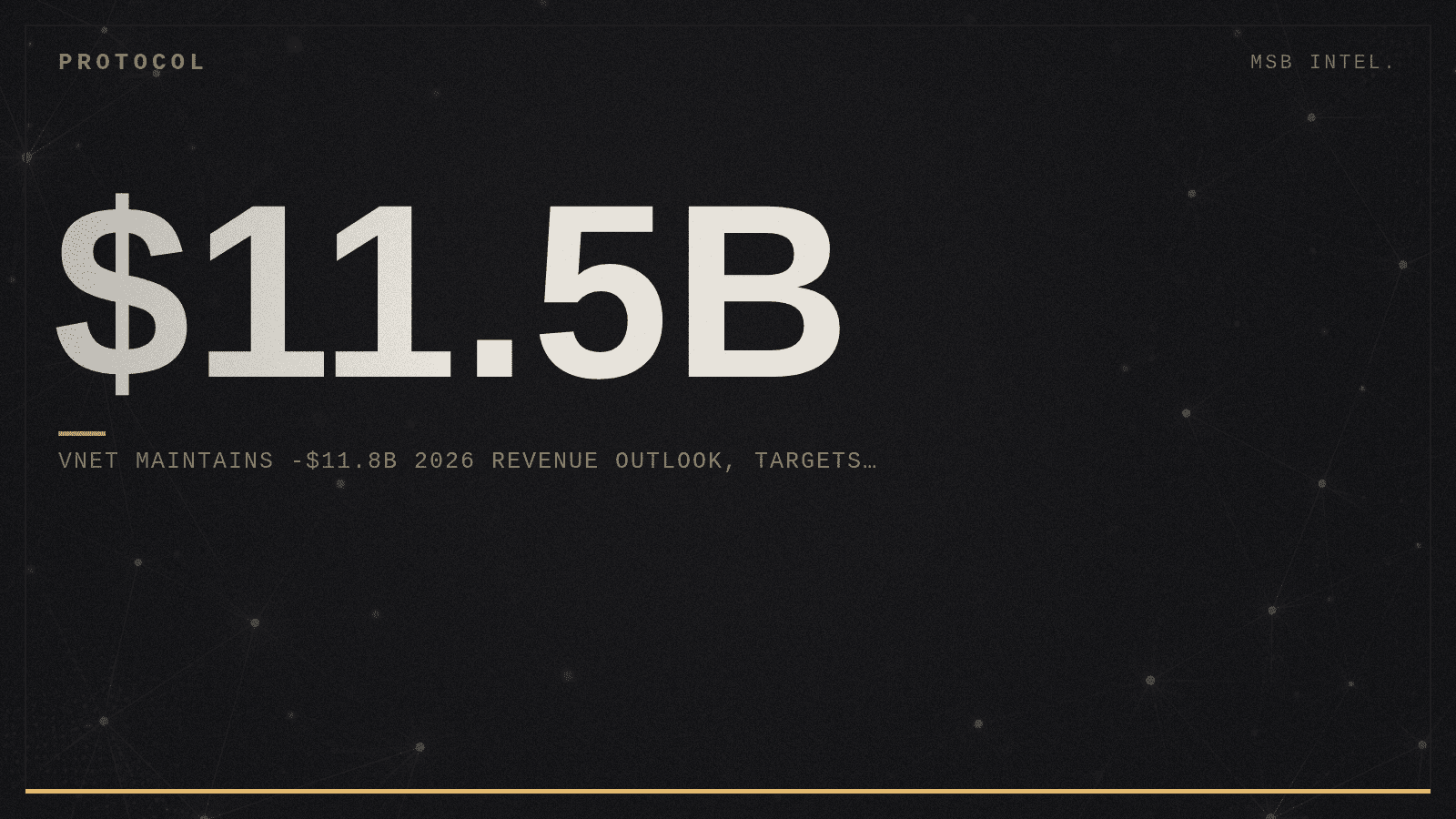
VNET Group reaffirmed its 2026 revenue guidance of $11.5 billion to $11.8 billion in renminbi while setting delivery targets of 450 to 500 megawatts of capacity, according to the company's Q2 earnings announcement made today.
The data center operator said wholesale capacity already exceeded 1 gigawatt by the end of the second quarter. The megawatt targets represent annual deployment levels tied to China's ongoing artificial intelligence infrastructure buildout, where wholesale capacity has become the primary metric for operator scale.
VNET operates data centers across mainland China with a focus on wholesale deployments to cloud service providers and AI training firms. The company segments its business into wholesale capacity, managed hosting, and cloud services. The 1 gigawatt-plus figure as of Q2 2026 marks cumulative operational and committed wholesale capacity across all phases.
The company's 450 to 500 megawatt delivery target for the full year 2026 implies an acceleration from prior periods, as wholesale operators in China face competing demand from hyperscalers building domestic large language model infrastructure. VNET had previously set capacity targets in the same range but refinement of this guidance came alongside the revenue restatement.

The revenue outlook in renminbi terms matches the composition of VNET's customer base and contract terms. The 2026 range translates approximately to $1.6 billion to $1.63 billion in US dollar terms at current exchange rates, though VNET reports primarily in renminbi to its investor base.
The company faces execution risk on both megawatt deliveries and revenue realization as China's data center construction cycles depend on hyperscaler spending, power grid availability, and regulatory approval timelines for new facilities. Competitive wholesale capacity has expanded across multiple operators simultaneously, compressing pricing in some regions.
VNET reaffirmed its guidance without announcing material disruptions to its construction pipeline or customer demand into year-end. The 450 to 500 megawatt target represents a 45 to 50 percent increase over typical prior-year quarterly delivery rates if distributed evenly across the full year, though deployment often concentrates in the final quarter.
The key figure to watch is whether VNET achieves the lower bound of 450 megawatts by December 31, 2026, as shortfalls below that level would indicate delays in power grid interconnection or customer buildout schedules that could carry into 2027.