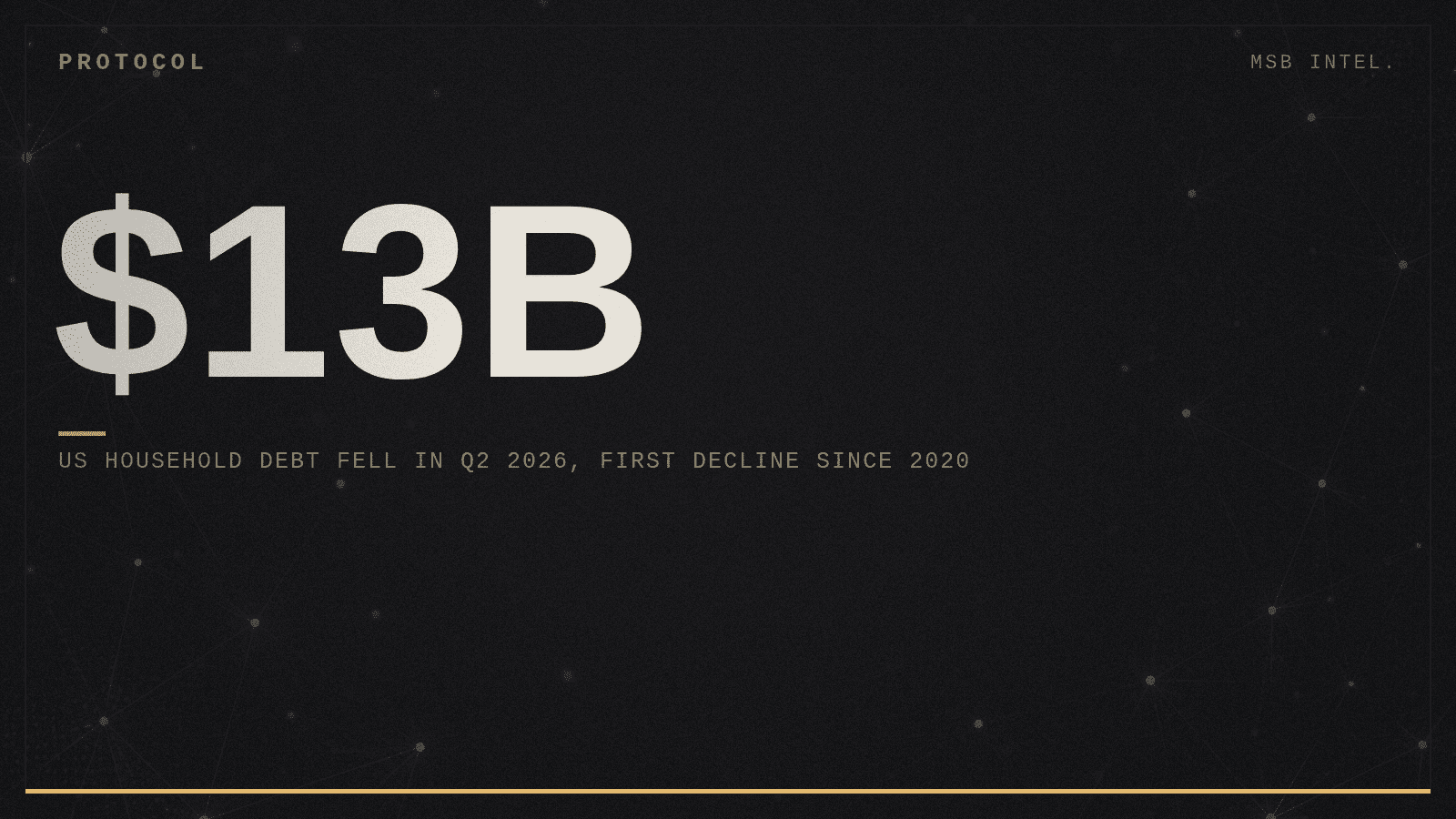
US household debt declined $13 billion in the second quarter of 2026, falling to $18.77 trillion, according to the New York Fed's quarterly report. The drop marks the first quarterly contraction since the start of the pandemic in 2020.
The decline was driven by a $74 billion fall in mortgage debt, which descended to $13.12 trillion. Student loan balances also fell by $7 billion to $1.65 trillion, their lowest level since the second quarter of 2025. Those decreases, however, came alongside significant increases in other categories of consumer borrowing that offset much of the gains.
Credit card debt rose $21 billion to $1.26 trillion in Q2, while auto loans jumped $28 billion to $1.71 trillion, an all-time high. Mortgages and student loans fell while auto borrowing hit record levels and credit card debt climbed.
Total US household debt has grown $4.63 trillion since the end of 2019, a period that encompasses both the pandemic and the subsequent recovery. The second-quarter decline represents a small reversal of that six-year trajectory but does not reverse the underlying trend of mounting consumer liabilities.

Auto loans have climbed steadily as vehicle prices remained high. Credit card balances have grown as consumers absorbed higher interest rates and carried more revolving debt month to month. Households are borrowing more in categories where debt burdens have historically grown fastest, even as mortgage refinancing activity and student loan repayment have eased overall liabilities in those categories.
The mortgage decline likely reflects lower origination volumes as refinancing activity slowed in a higher-rate environment, while student loan decreases followed the end of the federal payment moratorium. Auto lending has continued to extend credit for vehicle purchases despite economic headwinds, and credit card debt near its second-highest level on record shows sustained reliance on short-term borrowing.
Household debt as a share of total borrowing capacity has grown. The $13 billion quarterly decline, while noteworthy as the first contraction in six years, pales against the scale of the total stock and the pace of growth that preceded it. If auto loans and credit card debt continue climbing while mortgages and student loans stabilize or fall further, the composition of household liabilities will have shifted toward shorter-duration, higher-rate obligations. The document to watch is the New York Fed's Q3 2026 report, expected in November, to determine whether the second-quarter decline was a one-quarter dip or the start of a sustained deleveraging cycle.