
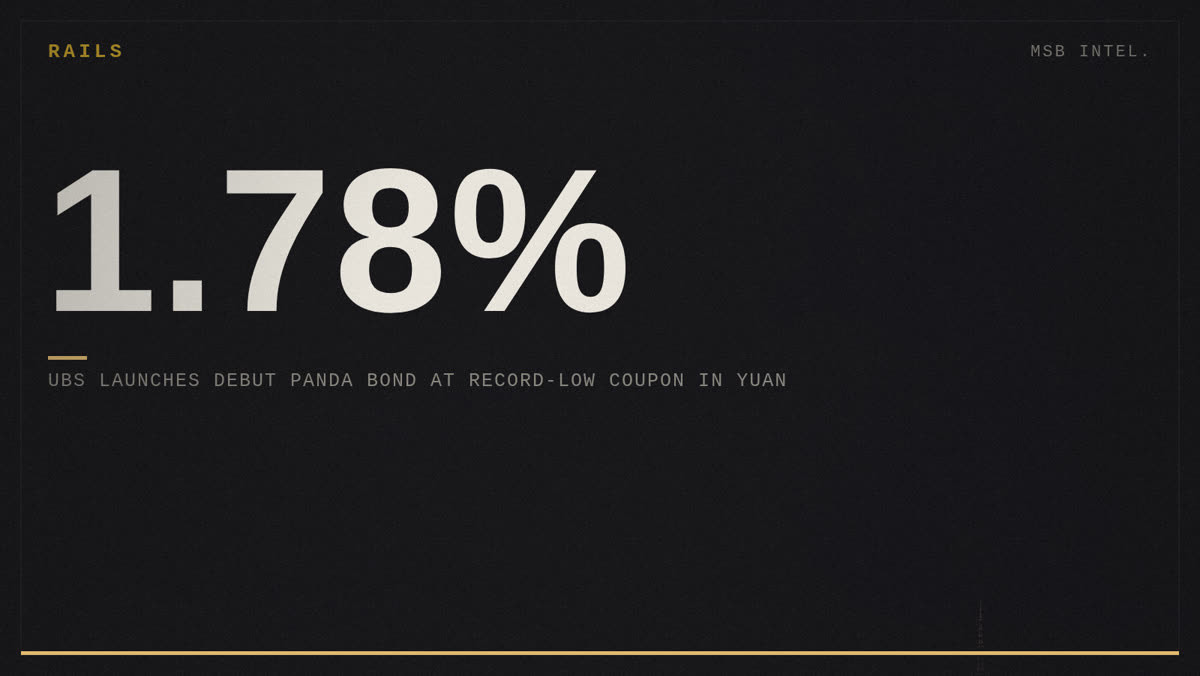
UBS Group AG priced its first Chinese domestic bond this week, issuing 2 billion yuan in five-year debt at a 1.78% coupon, becoming the first Swiss bank to tap China's onshore market and joining a growing cohort of foreign financial institutions capitalizing on lower domestic borrowing costs.
The coupon marks a record low for a foreign bank's inaugural panda bond, according to the issuance details. China's onshore rates have compressed as the government pursues stimulus measures, widening the gap between domestic and offshore funding costs for international issuers. Foreign banks have begun exploiting that spread: UBS's entry follows similar debuts by other global financial institutions seeking cheaper yuan-denominated capital.
Panda bonds are yuan-denominated securities issued by foreign entities in China's domestic market. The market remains heavily tilted toward Chinese government and state-owned enterprise issuers, but recent years have seen steady incremental foreign participation. Foreign issuance still represents a fraction of overall onshore bond volume.
UBS can borrow yuan domestically at rates materially below what offshore markets demand for equivalent duration and credit. The 1.78% coupon undercuts earlier foreign bank panda issuances. The issuance was likely sized and timed to test market depth ahead of potential follow-on offerings.

The onshore bond market remains under the People's Bank of China's regulatory purview, and foreign issuers must complete additional compliance and disclosure requirements absent in offshore markets. UBS's successful pricing came despite those friction costs.
UBS's inaugural panda bond at 1.78% sits 50 to 100 basis points lower than comparable foreign bank issuances in offshore yuan markets, a spread that would need to narrow significantly before the arbitrage closes. The bank now has a domestic funding channel previously unavailable to it, lowering its cost of capital in a key operating region.
The metric that decides whether this becomes a material capital markets trend is whether UBS or other newly arrived foreign banks return to the onshore market within six months for follow-on issuances at comparable or tighter spreads.