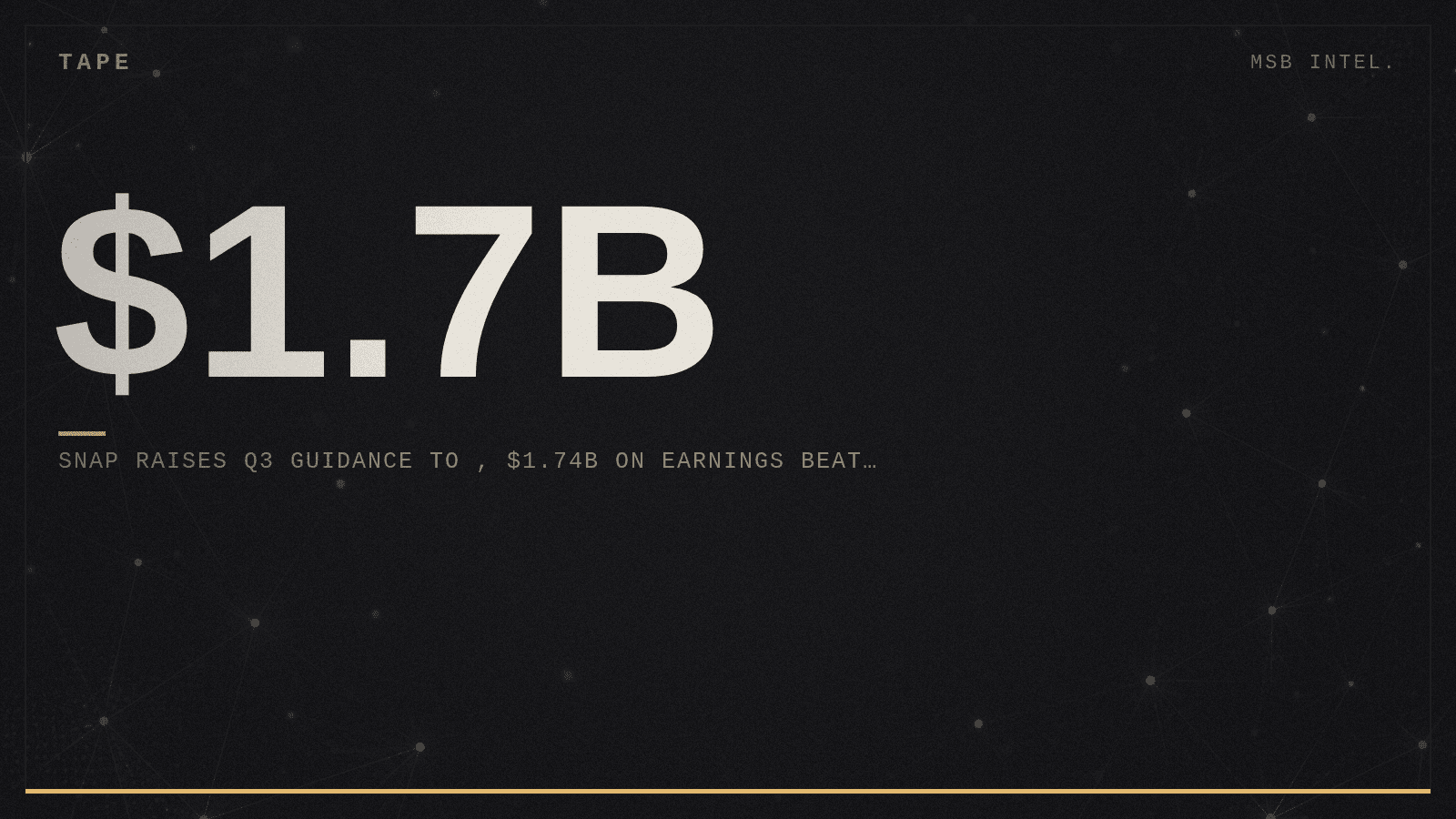
Snap reported second-quarter revenue of $1,599 million, a 19 percent increase year-over-year, and beat adjusted EBITDA expectations with $250 million against a $192 million estimate, prompting the company to raise third-quarter sales guidance to $1.7 billion to $1.74 billion, above consensus of $1.7 billion.
The earnings report, released August 3, also disclosed that infrastructure costs are climbing to $1.65 billion to $1.7 billion annually, a $50 million increase attributed to spending on artificial intelligence and machine learning systems. Companies across the platform economy are investing in AI-driven features and content recommendation systems to maintain competitive footing.
Snap's announcement showed the company's operating performance outpaced analyst models, with the EBITDA beat representing a 30 percent margin above consensus. Management raised its full-year outlook for the quarter ahead based on the result.
Snap's infrastructure costs now occupy a material line item in its cost structure. The $50 million year-over-year bump amounts to a 3 percent absolute increase to total operating expense guidance. Other social platforms and ad-tech firms have disclosed similar AI spending escalations in recent earnings, though the dollar magnitude varies by company size and deployment strategy.
The raise in Q3 guidance came as the company cited strength in advertiser demand and user engagement in its core markets. Snap does not break out AI spending separately in its cost disclosure, folding the allocation into the broader infrastructure line alongside server, storage and network costs. The company has been developing in-house AI tools for ad targeting and content personalization, work that typically requires sustained capital expenditure on compute capacity.
Snap's infrastructure cost guidance now sits at the high end of its historical 16-to-18 percent of revenue benchmark. The $50 million increase places AI-driven workloads as a structural element of its cost base rather than a temporary spike. Full-year 2026 infrastructure spending of $1.65 billion to $1.7 billion implies the company is operating in an inflationary period for compute and data center resources while also expanding the scope of AI capabilities across its platform.
Snap maintained EBITDA margin expansion while absorbing the $50 million cost increase, a result dependent on passing pressure through to advertisers and holding advertiser spending steady. The infrastructure cost trajectory will be a watch item for investors tracking the sustainability of social platform margins as AI model training and inference workloads grow in scale.