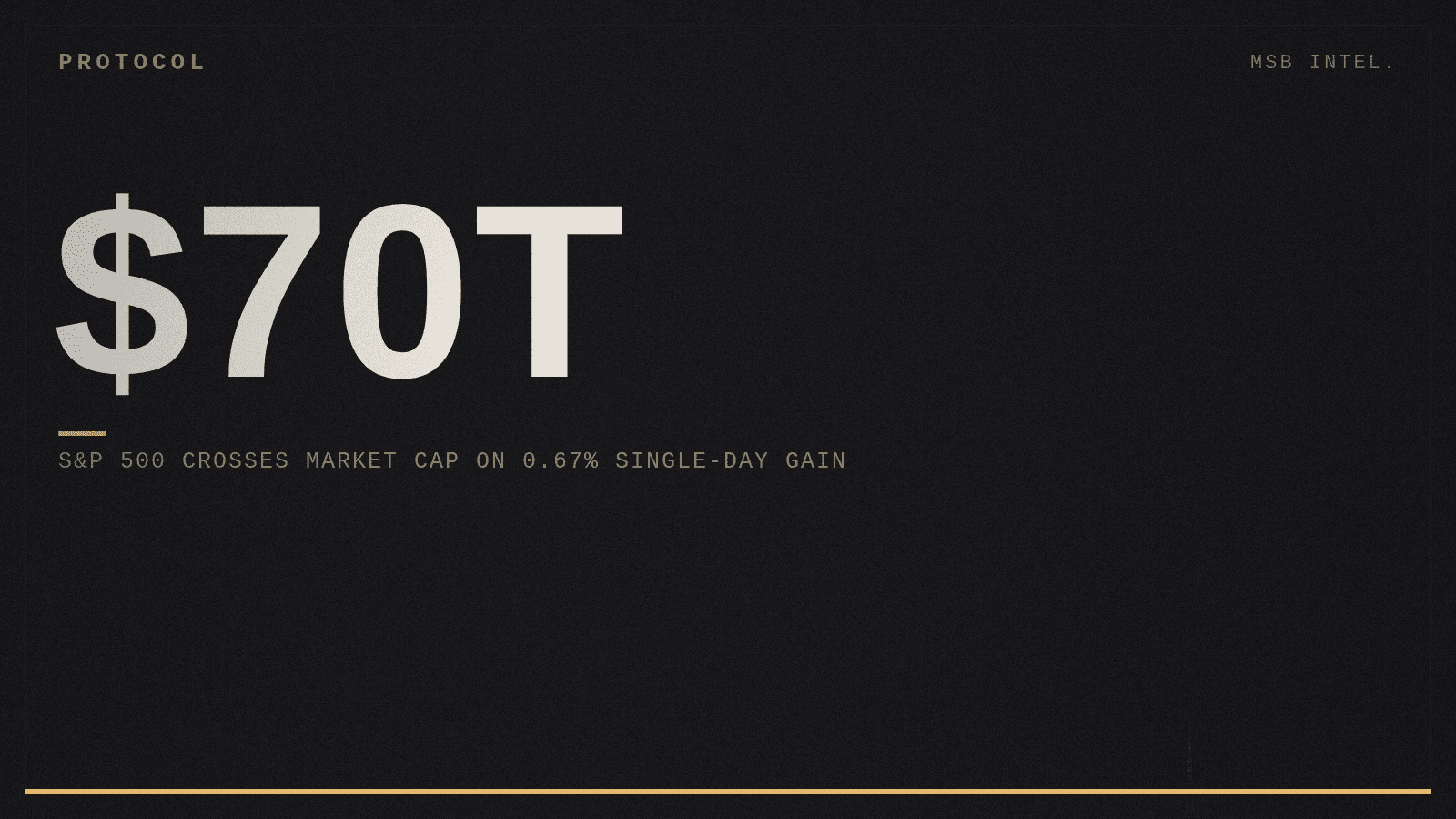
The S&P 500 reached $70.1 trillion in total market capitalization on August 27, 2026, adding roughly $469 billion in a single trading session as the index rose 0.67 percent to close at 7,727.
The move marks a milestone in absolute dollar terms for the benchmark. At current levels, the index has nearly doubled from its $36 trillion valuation in early 2020 and sits roughly 4.5 times larger than the $15.4 trillion total U.S. government debt outstanding as of mid-2026.
A post on X attributed the climb to strength in the broader asset owner economy, the segment of institutional and individual wealth holders whose portfolios track major equity indices. The single-day gain occurred amid a broader rally that saw major tech stocks and financial names lead market participation.

The $70 trillion threshold arrived after a sustained bull run from 2024 onward, during which the index recovered from bear-market lows in October 2022 near 3,491. The Federal Reserve shifted to rate cuts beginning in September 2024 and the absence of major economic disruption through 2026 supported valuations across large-cap equities.
S&P 500 companies traded at a forward price-to-earnings ratio near 21 times as of late August 2026, above the 20-year median of roughly 16 times, according to FactSet consensus data. The top 10 holdings represented approximately 33 percent of index weight.
The index has now gained $33.7 trillion in market value since the 2022 lows, a 96 percent advance in four years. Whether valuations can sustain at current levels depends on corporate earnings growth, Fed policy continuity, and geopolitical stability, variables that remain unsettled heading into the final months of 2026.
The number to watch is whether the S&P 500 holds above $70 trillion through a potential correction, or whether the index retreats toward the $65-68 trillion range if recession data or earnings disappointments emerge in the fourth quarter.