
Robinhood posted July metrics showing 28.5 million funded customers, $355 billion in platform assets, and $333 billion in equity trading volumes, with the latter two metrics climbing 19 percent and 59 percent year-over-year respectively.
The equity volume growth outpaced asset growth by a factor of three. Robinhood reported 324 million options contracts for the month, a 66 percent year-over-year increase.
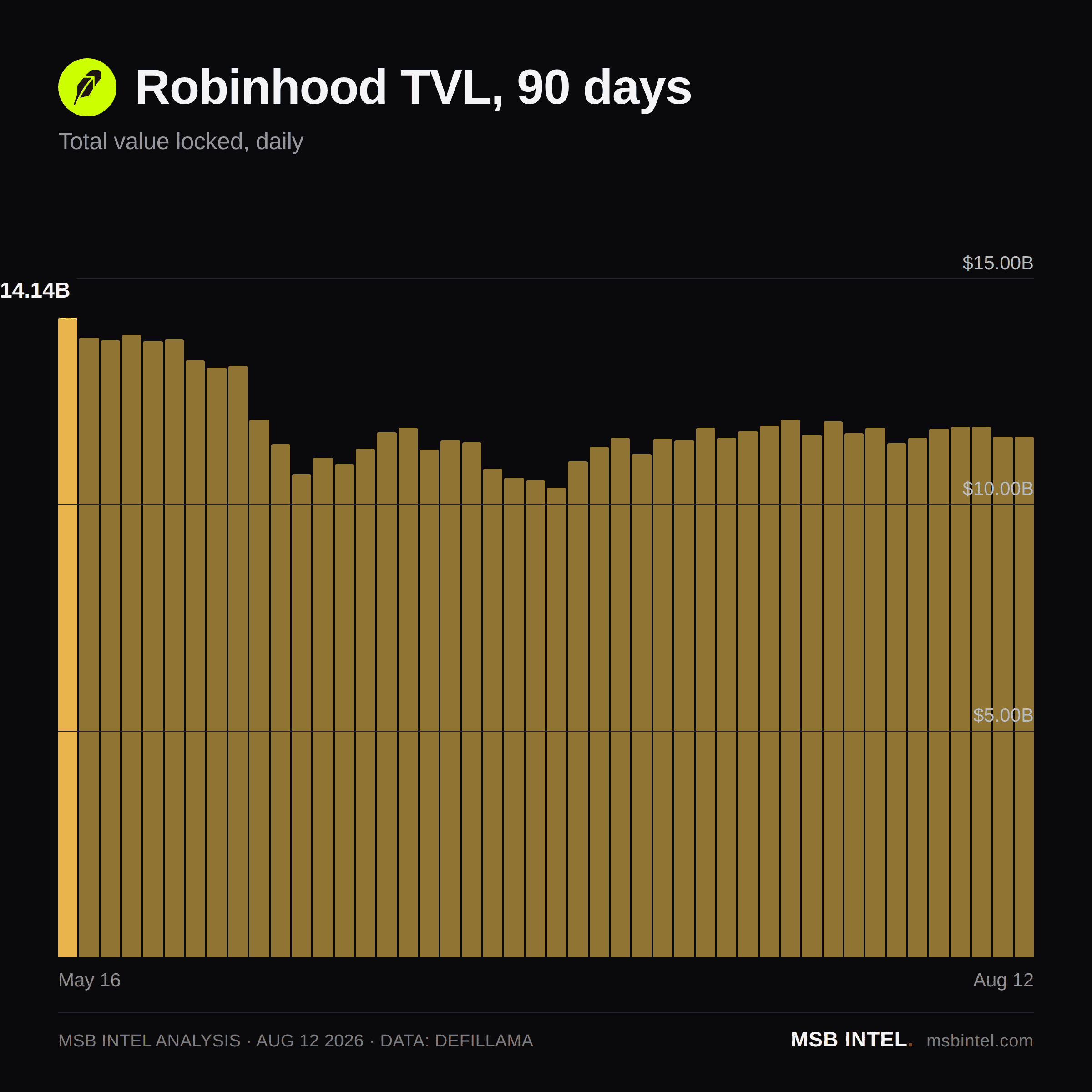
Robinhood has grown its funded customer base by 1.8 million accounts in the past year, a rate of 6.7 percent annually. Equity volumes of $333 billion stand against customer growth of 1.8 million, while options contracts hit 324 million in a single month.

The $355 billion figure includes total assets on the platform across equities, options, crypto, and cash products. Robinhood does not separately disclose how much of that total derives from crypto holdings, which have grown substantially as Bitcoin and Ethereum prices recovered through 2024 and into 2025.
Equity volumes of $333 billion annualize to roughly $4 trillion in notional trading, a scale that places Robinhood among the largest retail brokers by trading intensity. For comparison, E-Trade and Charles Schwab combined for approximately $6.8 trillion in equity notional volumes in their most recent reported quarters, though those figures include both retail and institutional flow.
Robinhood's options contract count of 324 million in a single month translates to 3.9 billion contracts annualized. The company has been pushing deeper into options since 2023, when it eliminated commissions on multi-leg spreads and complex orders.
The 59 percent year-over-year growth in equity volumes substantially exceeds the 19 percent growth in total platform assets. Customer growth of 6.7 percent annually cannot account for the 59 percent jump in volumes, meaning per-customer trading frequency or order size has risen.