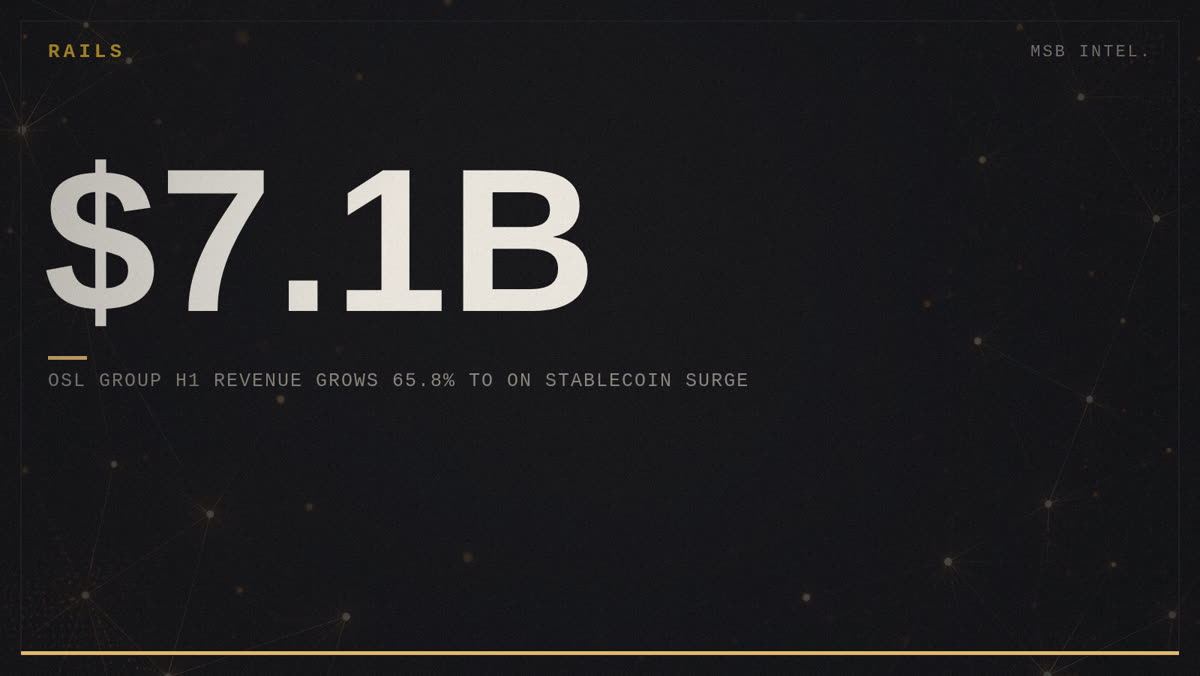
Hong Kong-based OSL Group reported interim results for the first half of 2026 showing revenue of HK$55.8 billion, or roughly $7.1 billion USD, up 65.8 percent from the same period last year. Adjusted non-IFRS income rose 75.5 percent to HK$331 million, approximately $42.4 million USD.
The company said it has become the world's largest provider of B2B stablecoin payment infrastructure, a segment that processed $12.3 billion in volume during 2025. OSL's growth rate exceeded gains reported by major crypto exchanges in comparable periods, where institutional volumes have recovered but retail activity remains volatile.
OSL operates as a licensed digital asset exchange and custodian in Hong Kong under the Securities and Futures Commission's regulatory framework. The company earlier received approval to conduct Type 1 and Type 7 regulated activities, positioning it as one of the few jurisdictions where institutional crypto trading and asset services operate under formal supervision. Its H1 results arise from both its core trading and exchange business and the newer B2B stablecoin payment unit that connects enterprise clients to on-chain settlement.
Stablecoin infrastructure for business-to-business payments has grown as corporations and financial institutions seek alternatives to traditional payment rails. The $12.3 billion in 2025 volume represents transaction throughput rather than balance held. OSL's claim to hold the largest share of this segment would make it a significant player in the emerging category, though the B2B stablecoin market remains nascent and fragmented across multiple service providers including Ripple, Circle, and other protocol-level operators.
The adjusted income figure excludes certain one-time items and non-cash charges under IFRS accounting. OSL's disclosure of both IFRS and adjusted metrics is standard practice among Hong Kong-listed financial services firms.
OSL's H1 results arrived as Hong Kong continues efforts to position itself as a regional crypto hub, competing with Singapore and other Asian financial centers for institutional digital asset business.
The metric to watch is whether OSL sustains its B2B stablecoin volume growth beyond 2026, as regulatory clarity and enterprise adoption in traditional finance will determine whether the category becomes a material revenue stream or remains a small fraction of institutional crypto infrastructure.