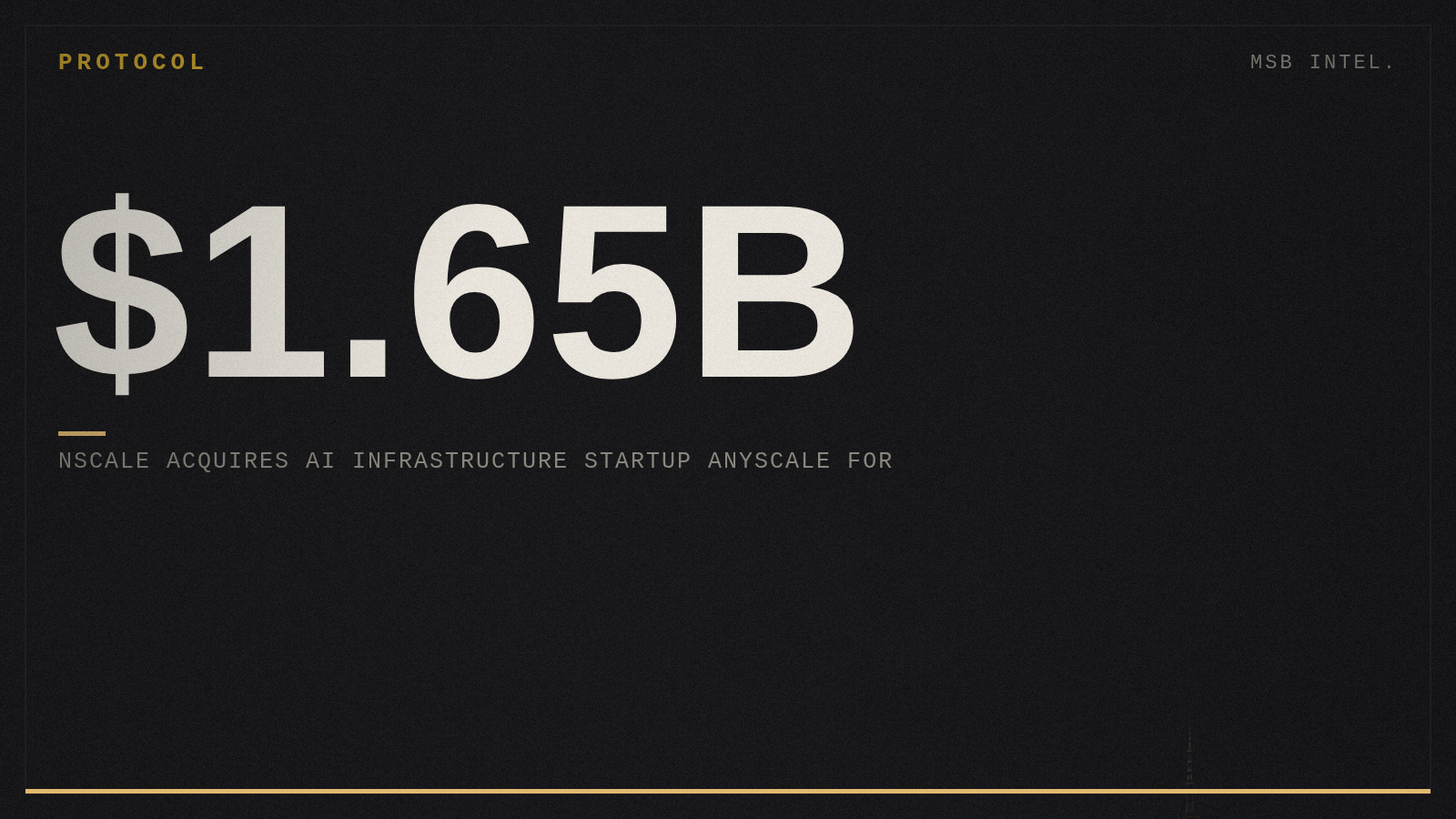
Nscale has acquired Anyscale, an AI infrastructure optimization startup, for $1.65 billion, according to the company's announcement. The deal, announced July 30, marks a consolidation play in the distributed computing layer that powers large-scale AI workloads.
Anyscale builds Ray, an open-source framework for distributed machine learning and AI inference. Ray abstracts away the complexity of orchestrating workloads across clusters of GPUs and CPUs, letting engineers scale training and serving jobs without rewriting application code. By acquiring Anyscale, Nscale is moving to own more of the full-stack AI infrastructure chain that runs from silicon through orchestration to the cloud platform itself.
Anyscale has grown into a critical chokepoint in production AI. Companies including OpenAI, Shopify, and JPMorgan have adopted Ray to manage compute-heavy workloads. The open-source project has become so embedded in the ecosystem that Anyscale's commercial offering, managed Ray hosting and optimization tooling, faces natural adoption friction: many teams already run Ray for free and prefer not to pay for hosting when they can run it themselves on cloud providers like AWS, Google Cloud, or Azure.
Nscale, itself a major GPU compute provider and cloud infrastructure company, now controls the orchestration layer that sits between its own hardware offerings and customer applications. This vertical integration lets Nscale tune Ray's scheduler and memory management to favor its own infrastructure and optimize the economics of its compute sales. The company can also bundle Ray access into infrastructure contracts, reducing churn and deepening customer lock-in.
The acquisition price implies Anyscale was valued at $1.65 billion on an estimated 2025 revenue of around $150 million, according to publicly available reports. That multiple reflects both the strategic value of the Ray install base and ongoing uncertainty around Anyscale's path to profitability as a standalone vendor competing against free open-source usage.
Nscale has spent the past two years building out its cloud platform to compete with hyperscalers on AI workload acceleration. In 2024, the company raised $1.1 billion in venture funding at a $19 billion valuation. This acquisition is the largest infrastructure tuck-in by a private compute company this cycle. GPU margins are compressing under hyperscaler competition, and infrastructure vendors are moving up the stack to capture software licensing and platform fees.
The deal still requires regulatory approval in certain jurisdictions. Both companies operate primarily in the United States and Europe, where competition authorities have scrutinized vertical integration in cloud infrastructure.