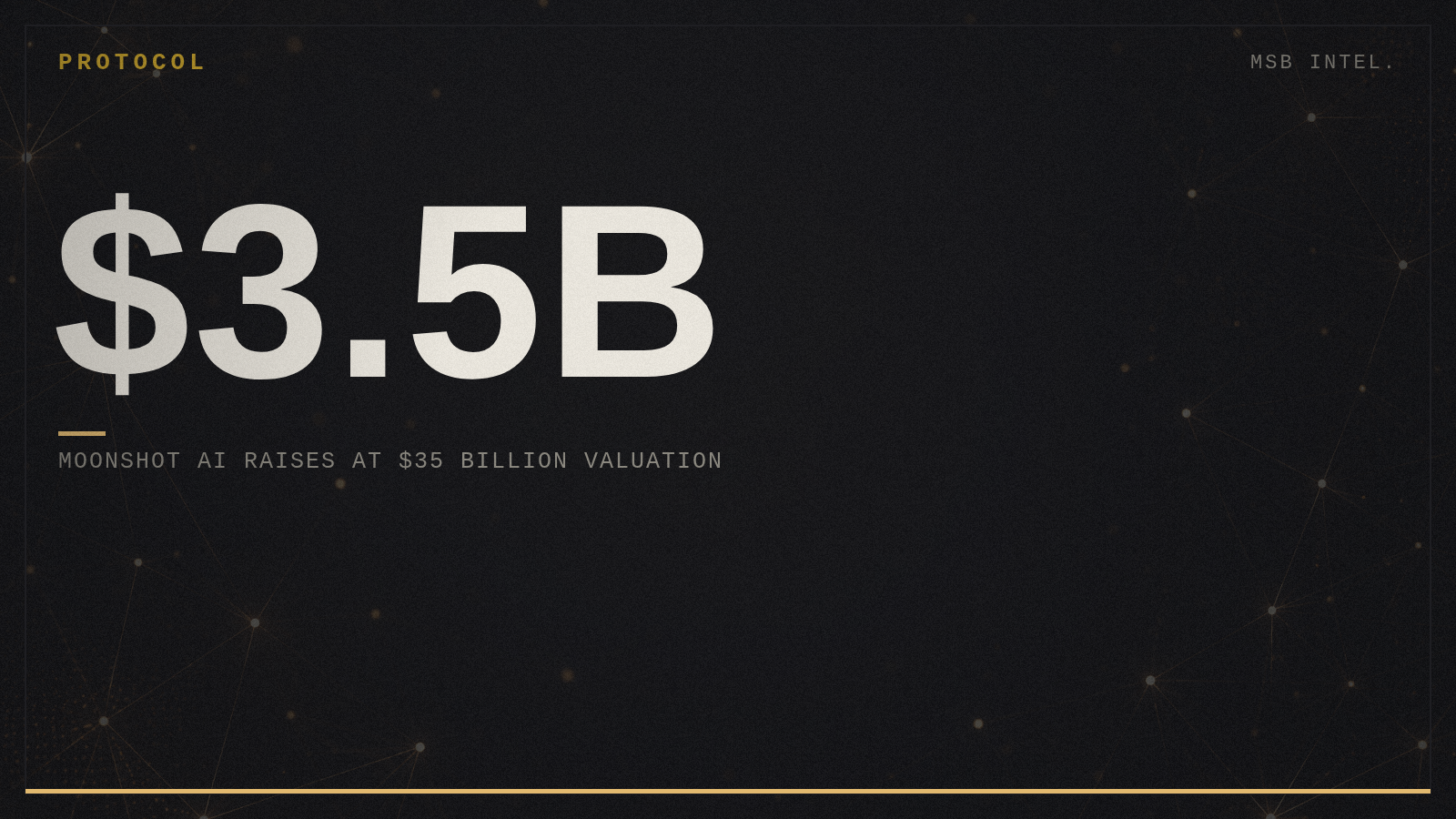
Moonshot AI closed a $3.5 billion funding round at a $35 billion post-money valuation, according to Bloomberg reporting on the deal completed in late July. The Chinese AI company is planning a Hong Kong initial public offering as a next step.
Moonshot AI, founded in 2023 by former Baidu researcher Yang Zhilin, has grown to become one of the largest Chinese generative AI startups outside of Baidu and Alibaba. The company's core product is Kimi, a large language model available via web and mobile interfaces. Previous fundraising rounds valued the company at lower multiples; the $35 billion valuation represents a significant step-up from earlier rounds as domestic and international investors have competed for exposure to China's AI sector.
The $3.5 billion round drew participation from existing backers and new institutional investors. Moonshot AI's rapid scaling comes as Chinese large language models including Baidu's Ernie, Alibaba's Qwen, DeepSeek, and Zhipu have all raised substantial capital over the past 18 months. Moonshot's raise places it among the largest single funding events in the Chinese AI space this year by dollar amount.
Hong Kong regulators and the local financial infrastructure have become a preferred destination for Chinese tech IPOs since 2024, particularly for companies seeking capital markets access without the regulatory scrutiny that direct U.S. listings face. A Hong Kong listing would allow Moonshot to raise additional capital and offer founder and investor liquidity, though a specific timeline for the IPO has not been disclosed.
The company is also competing for enterprise adoption, positioning Kimi as a productivity tool in markets where OpenAI's ChatGPT and Anthropic's Claude face deployment restrictions. Moonshot's valuation at roughly 6.7 times its latest funding round size, a common ratio for mature venture-stage AI companies, places it in line with comparable privately held AI developers, though well below public AI infrastructure companies trading at higher multiples.
The fundraising round closes out a wave of capital concentration in China's AI sector that began in 2024. Moonshot will need to demonstrate sustained user growth and enterprise revenue traction to justify the valuation ahead of any IPO filing. The timing and terms of the Hong Kong listing, if and when Moonshot files, will determine how Hong Kong regulators and anchor investors view the commercial maturity of Chinese large language models.