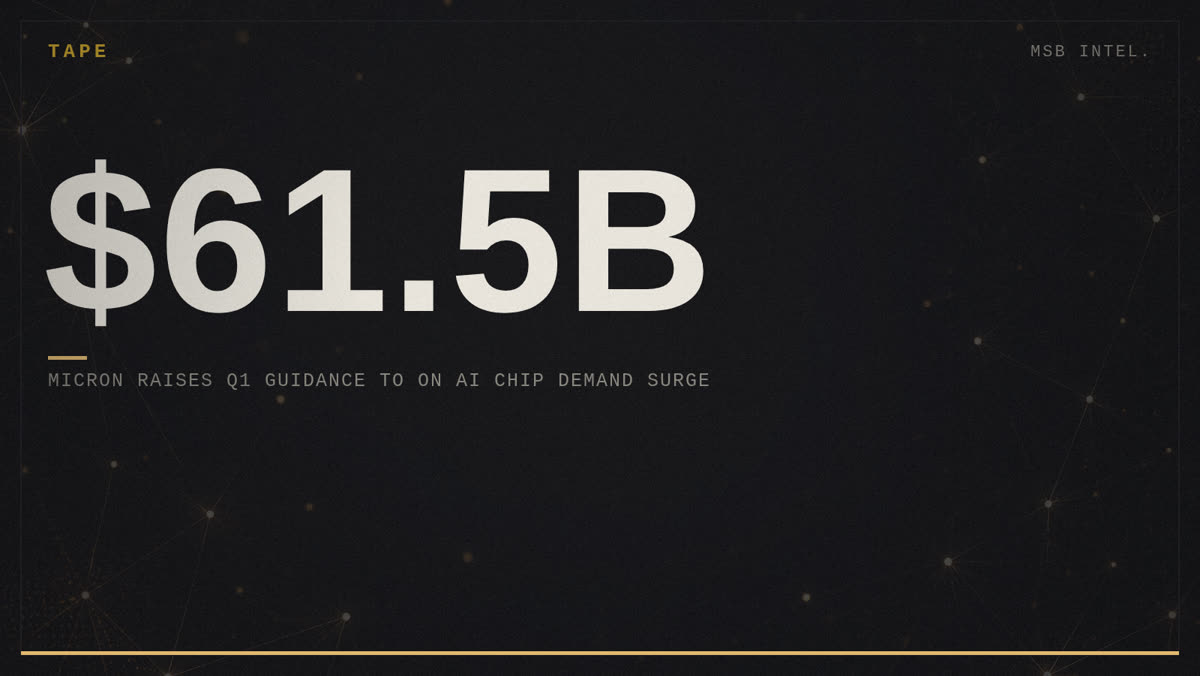
Micron Technology raised its first-quarter revenue guidance to $61.5 billion, exceeding analyst expectations of $56.8 billion to $57 billion, citing accelerating demand for AI chips. The chipmaker warned that rising employee compensation and startup costs totaling approximately $1 billion would pressure profit margins despite the revenue beat.
Micron competes directly with SK Hynix and Samsung for memory chip orders from cloud operators racing to deploy AI infrastructure. The margin headwind comes as the company hires and scales capacity to meet data center demand. Sustaining revenue growth in the AI cycle requires hiring and retention spending that shrinks per-unit profitability in the near term.
The announcement came as Micron finished its fiscal fourth quarter in September 2026. The company cited strength in high-bandwidth memory, a specialized chip architecture critical for large language model training and inference. Micron's own demand matters: as a supplier to virtually every major cloud operator, its forecast carries weight beyond the company's own results.
Memory chip makers have faced margin compression cycles before. During the 2018 cycle, DRAM and NAND flash prices collapsed as excess capacity flooded the market. The current environment inverts that risk: demand is outpacing supply, but the cost of maintaining that leadership is rising faster than prices. Micron's $1 billion compensation figure shows the company expects this imbalance to persist long enough to justify sustained hiring.
Analyst guidance had ranged conservatively because memory markets move on supply-demand swings that are difficult to forecast. Micron's beat means that the AI cycle's capacity constraints remain real at least through the first half of 2027. The margin warning shows equally that this advantage cannot be converted into proportional profit growth without cost control.
Micron's guidance implies revenue growth of 8.2 percent quarter-over-quarter at the midpoint of prior guidance, a pace well above the memory industry's historical norm of 2 to 4 percent. If the company sustains $61 billion-plus quarterly runs through 2027, it would nearly double annual revenues compared to fiscal 2025. The $1 billion in incremental labor and startup costs amounts to roughly 1.6 percent of the new guidance, a material but not catastrophic drag on operating leverage.
The number that decides whether Micron's margin warning is temporary growth pains or a structural shift is the company's operating margin in the quarters following Q1 guidance. If compensation costs remain fixed while revenue plateaus, margin pressure deepens. If revenue continues to accelerate faster than headcount, the compensation drag shrinks as a percentage of sales.