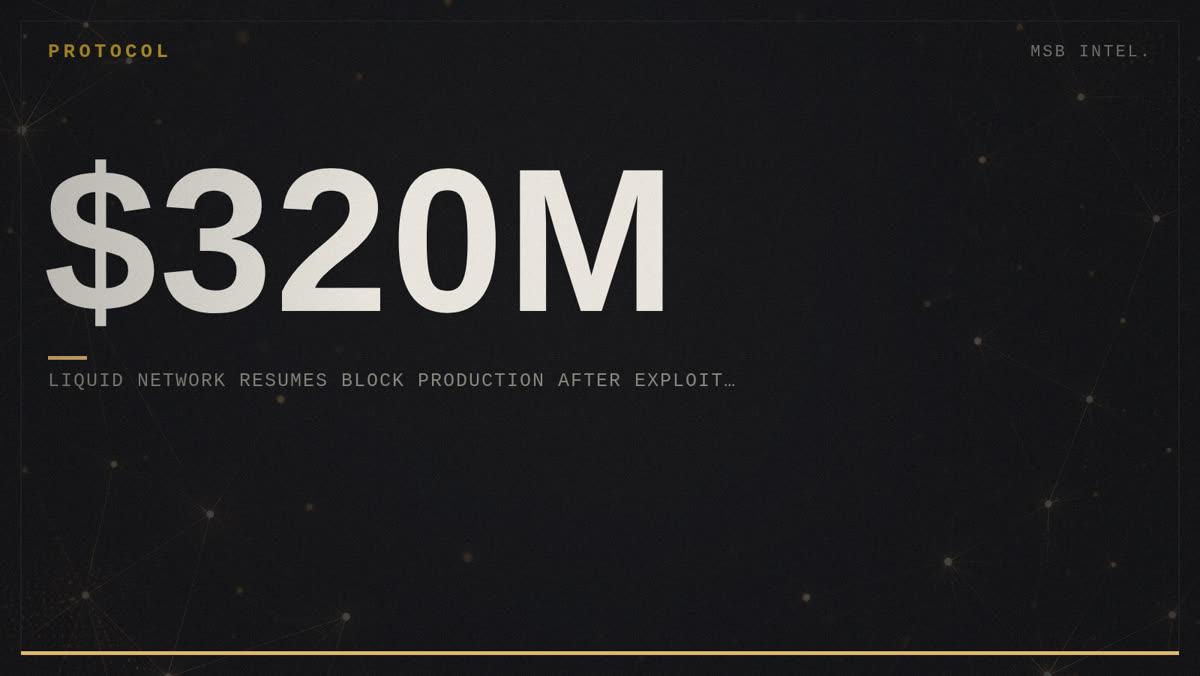
Liquid Network restarted block production after deploying emergency software updates following a $320 million exploit, according to an announcement on X. Transactions and peg operations, the mechanism allowing users to convert bitcoin to and from the sidechain's wrapped token, remain suspended as recovery efforts proceed.
Liquid is a sidechain operated by Blockstream that allows faster transactions and privacy features for bitcoin holders who lock their BTC to mint pegged tokens on the network. The sidechain processes roughly $500 million in total value locked across user deposits and reserves. A security breach in early September exposed a vulnerability in Liquid's consensus or asset management layer, enabling an attacker to extract approximately 4,000 bitcoin equivalent to the network at current valuations.
The network's developers deployed patches to the node software and reactivated block production on September 10, according to the X post. Block production, the continuous validation and timestamping of new blocks, had halted entirely after the exploit was detected, freezing all network activity. The resumption means the ledger is advancing again, though users cannot yet move funds or initiate peg-ins and peg-outs.

Liquid's peg operations depend on a federation of signers who hold custody of bitcoin reserves backing the circulating supply of L-BTC, Liquid's wrapped token. Keeping peg operations suspended protects against further unauthorized asset moves while developers audit the full extent of the compromise. Blockstream and Liquid stakeholders have not yet detailed a timeline for restoring transaction processing or peg functionality.
The incident exposed a critical vector in wrapped-asset sidechains: the security of the federation and the consensus layer that validates peg transactions must withstand both technical attack and social consensus failure. Liquid's restart sequence, halting user activity first, patching software second, and restoring block production before transaction settlement, is a standard containment pattern for stolen-asset recoveries in blockchain infrastructure.
Liquid Network serves institutional traders and privacy-focused users; its downtime directly affects exchanges and custodians holding L-BTC for trading pairs or collateral. The federation has stated that users' original bitcoin deposits held in multisig custody remain secure, though L-BTC holders face temporary inability to redeem or transfer their sidechain holdings. If Liquid does not restore peg operations within 72 hours, pressure will mount on exchanges to pause L-BTC trading or flag accounts that cannot settle positions.