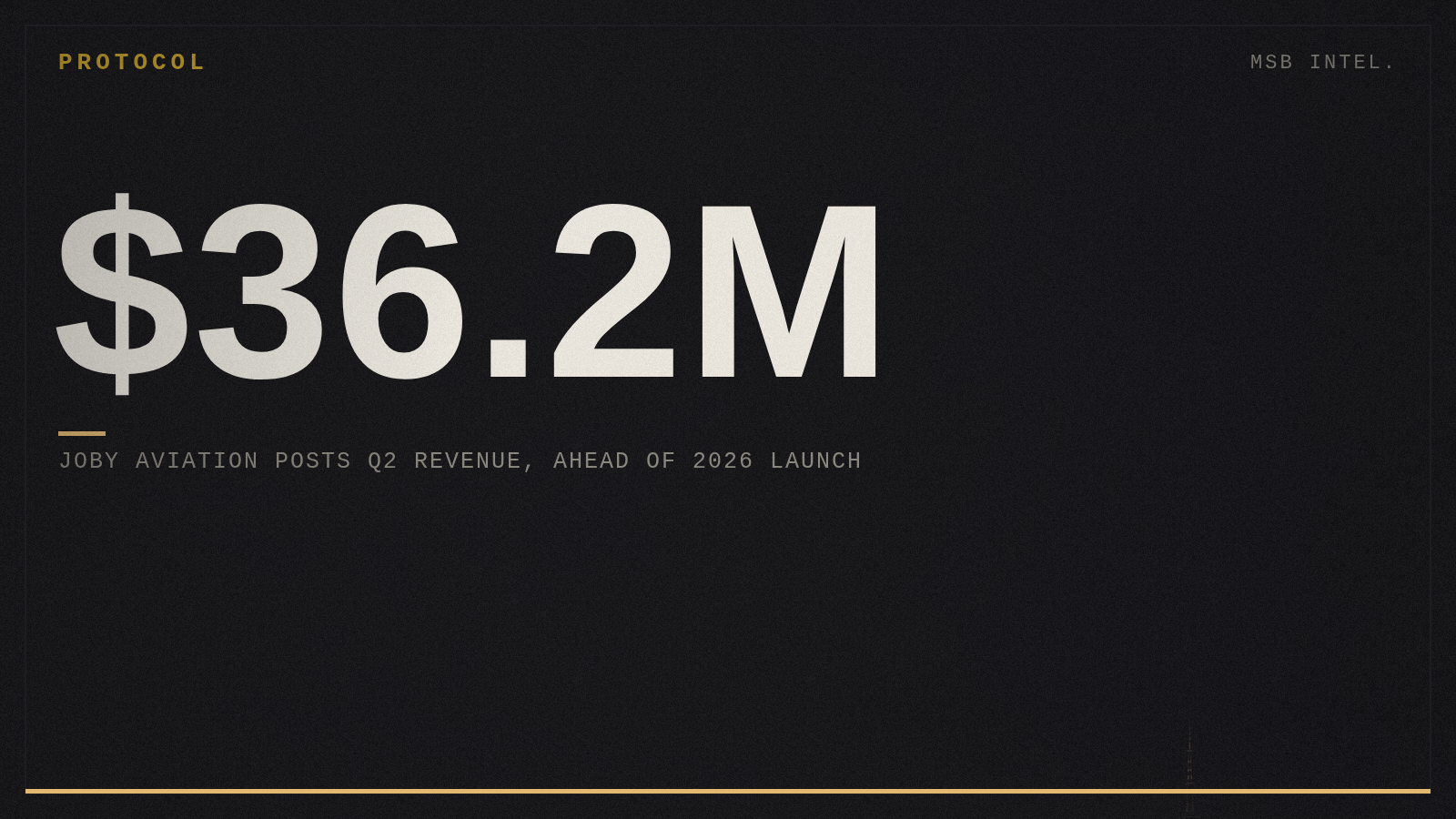
Joby Aviation reported second-quarter revenue of $36.2 million, exceeding analyst consensus estimates of $29 million to $30.2 million, according to the company's financial results announcement. The air taxi manufacturer is advancing toward commercial operations next year with five aircraft in active flight testing and 12 more in production.
The quarter marks Joby's strongest regulatory progress to date. The company has reached Stage 5 of 5 in FAA Type Certification, the final phase before the aircraft can carry paying passengers. Joby is one of three companies pursuing federal certification for electric vertical takeoff and landing aircraft, competing against Archer Aviation and Lilium International. Unlike those rivals, Joby has already secured a production partner in Toyota, announced in 2023.
Joby's path to certification has narrowed significantly since 2024. The company completed its first crewed flight test of its JB01 aircraft in May 2024, nine months ahead of its public timeline. By the end of 2024, it held the only FAA approval for Phase 2 flight testing of a commercial eVTOL aircraft. Archer Aviation sought similar approvals starting in late 2024 and received them in mid-2025; Lilium has not yet reached that milestone.
The company has burned cash throughout development. Joby's operating cash burn in the first half of 2026 exceeded $450 million, and the company has repeatedly raised capital to fund manufacturing and certification. In May 2026, Joby completed a $500 million PIPE investment at $12 per share, months after its SPAC merger at $9 per share in August 2023. The stock has traded between $5 and $16 over the past 12 months.

Joby operates under a conditional certification basis that the FAA established in 2022, which allows the regulator to set safety requirements for a new aircraft category rather than forcing eVTOL makers to fit existing airplane or helicopter rules. The path remains untested; no eVTOL aircraft has yet received the final Type Certification that permits commercial passenger operations. The framework assumes one manufacturer will achieve it first, setting a precedent for others.
Joby's lead in testing and manufacturing depth give it a measurable advantage. The company is operating five flight-test aircraft against Archer's single airframe in active testing as of mid-2026. Joby's 12-aircraft production pipeline also outnumbers Archer's nearest comparable capacity by four times. That advantage in cadence matters; FAA certification timelines depend partly on the regulator's ability to observe variability across production units, not just prototypes.
The revenue beat and manufacturing acceleration narrow the timeline to Joby's claimed 2026 commercial launch window, though the FAA has not yet issued a final Type Certification date. If Joby does not receive that certification by end of 2026, the company's cash position and investor appetite for additional rounds will face immediate pressure. The next disclosed earnings date and cash balance report is expected in November 2026.