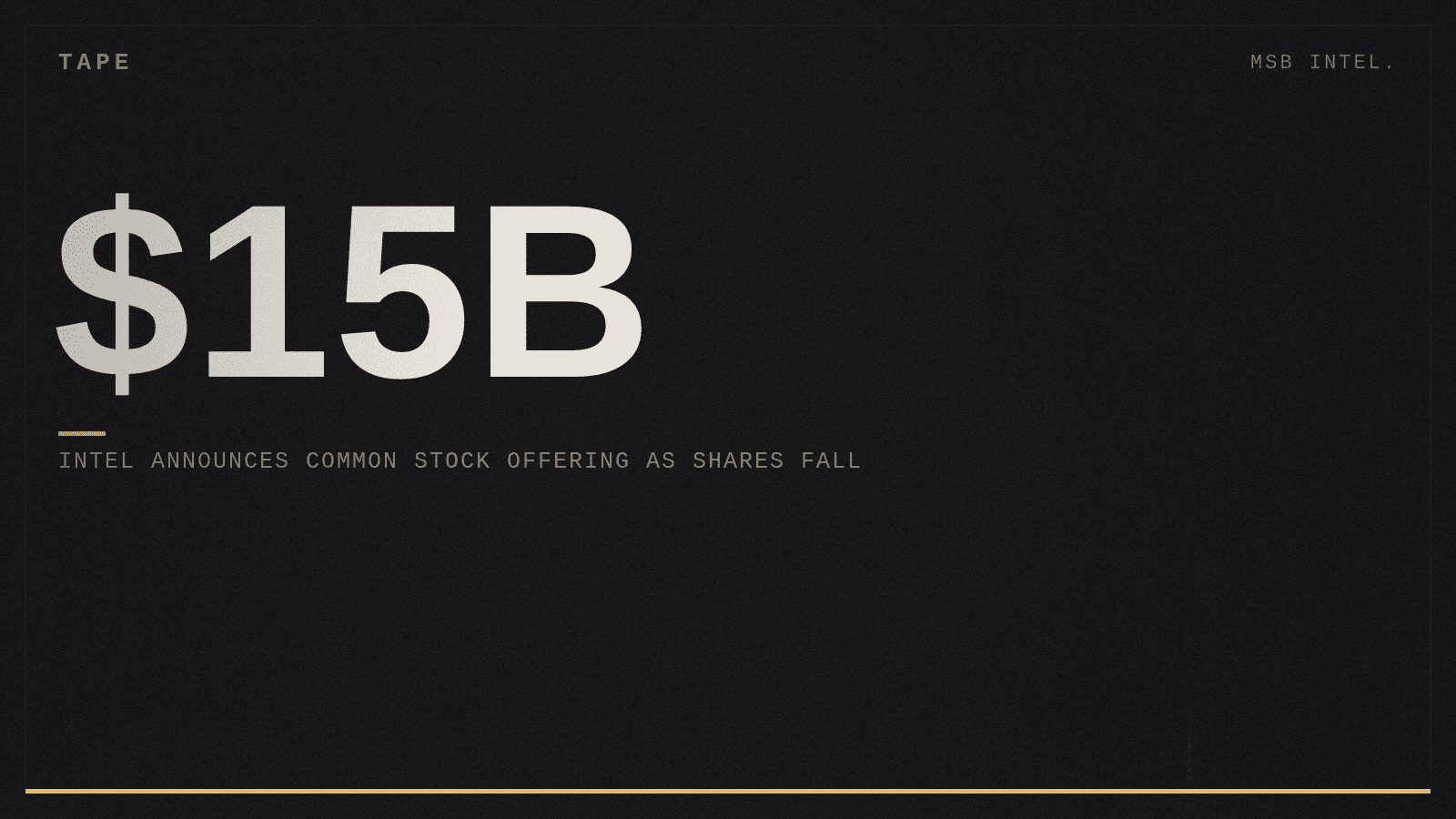
Intel announced a $15 billion underwritten public offering of common stock on Monday, with shares declining 3.5% in premarket trading.
The chip maker is raising capital as it commits billions to manufacturing and research. Intel has funded domestic fab construction under the CHIPS Act and faces competition from rivals including Taiwan Semiconductor Manufacturing Company, which reported a 45% year-over-year sales jump on Monday amid strong artificial intelligence demand.
The offering is a common stock sale, meaning it will dilute existing shareholders. Intel did not specify the number of shares to be offered or pricing details in initial disclosures, which typically come after underwriter roadshows and market conditions assessment. The company has authority to set terms within the $15 billion envelope.
Intel's capital raise comes as the semiconductor industry grapples with the cost of maintaining process leadership. The company has spent tens of billions on fabs in Arizona, Ohio, and New Mexico. A $15 billion offering represents roughly 5.4% of Intel's current market capitalization, assuming a valuation near $280 billion based on recent trading.

The premarket decline reflects typical market reaction to dilutive equity issuance. Competitors including Advanced Micro Devices and Nvidia have relied on debt and operating cash flow rather than equity raises to fund expansion. Intel generated $24.9 billion in operating cash flow in 2025, according to company filings.
The announcement arrives as Apple supplier dynamics shift. Jefferies downgraded Apple on Monday, citing canceled all-glass iPhone plans, soaring memory costs, and expected earnings-per-share cuts tied to iPhone 18 sales pressure. Memory and processor costs for device makers have risen as AI chip demand has tightened supply across the industry.
Intel's stock has traded in a narrow range year-to-date, lagging the broader semiconductor sector. The company's 2024 earnings disappointed investors, and management has committed to multi-year spending that will weigh on near-term profitability. The $15 billion raise provides runway to continue those commitments without additional debt issuance.
Semiconductor capital raises through equity have been rare since 2020. Most large-cap chipmakers have preferred debt markets or internal cash generation. Intel's choice to tap equity markets now depends on long-term demand for U.S. manufacturing capacity.