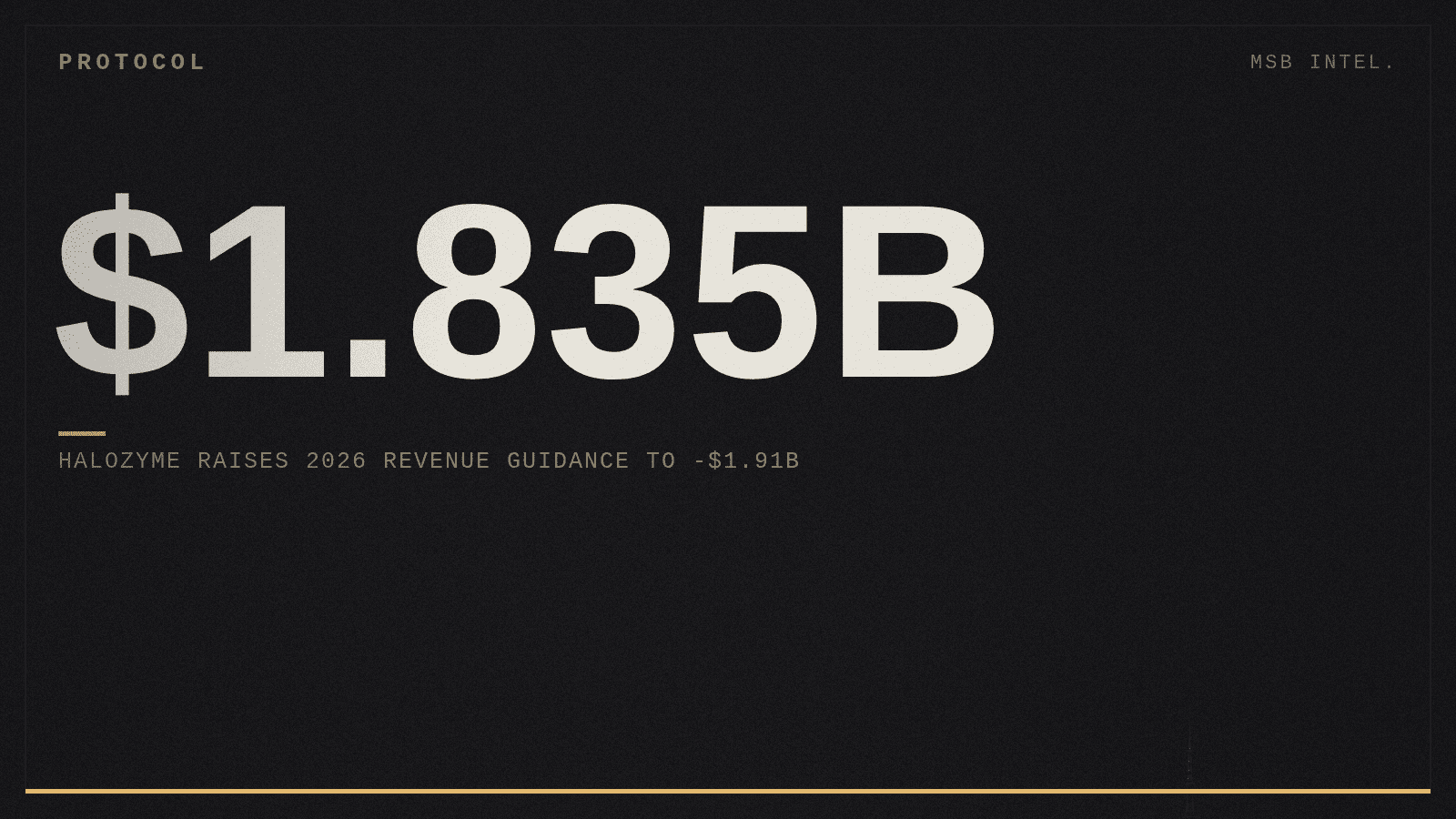
Halozyme raised its full-year 2026 revenue outlook to $1.835 billion to $1.91 billion, up from prior guidance of $1.71 billion to $1.81 billion, according to the company's announcement. The company also lifted non-GAAP earnings per share guidance to $8.65 to $9.00 from $7.75 to $8.25.
The increase stems from stronger-than-expected operational performance. Halozyme reported second-quarter 2026 results that beat analyst estimates, with royalty revenue growing 50 percent year-over-year. The company had previously set its 2026 guidance in May at the lower range, leaving room for increases as the year progressed.
Halozyme is a NASDAQ-listed specialty pharmaceutical company that generates revenue through two primary channels: product sales for its injectable hyaluronic acid-based portfolio and royalties from partner companies using its technology platform. Royalties have become a material growth driver, accounting for the accelerated pace of the guidance raise. The company reported full-year 2025 revenue of $1.4 billion, making the midpoint of the new 2026 guidance roughly 30 percent above that baseline.
The guidance raise marks the second increase this year. Halozyme reaffirmed its 2026 outlook in April when reporting first-quarter results, but the subsequent quarter's performance proved strong enough to warrant upward revision of both revenue and earnings metrics. The non-GAAP EPS range widened to $8.65 to $9.00, a 12 percent increase at the midpoint versus the prior $7.75 to $8.25 range.

Halozyme operates in the injectable medicines space, where partner demand for its proprietary transdermal and subcutaneous delivery technologies creates recurring royalty streams. The 50 percent royalty growth rate reported for the quarter far outpaced the company's product revenue trajectory. Licensed technology partnerships are expanding faster than internal product sales, and this diversification into recurring revenue has broadened the company's visibility into 2026 performance.
Two consecutive guidance raises in a single fiscal year are uncommon for large-cap pharmaceutical companies. Halozyme's case appears driven by faster-than-expected adoption of its licensed platform by partner companies, which carry no manufacturing or sales risk for Halozyme itself. The company now projects non-GAAP EPS growth of 12 to 20 percent from the 2025 implied baseline, depending on where 2025 actual EPS landed relative to the company's prior expectations.
Investors and allocators track pharmaceutical guidance raises to assess demand durability and margin stability. Halozyme raised guidance on both revenue and earnings in the second half of the fiscal year, driven chiefly by royalty acceleration from its licensed platform. The measure to watch is whether Halozyme reaffirms this guidance through year-end or raises it again when reporting Q3 results in October.