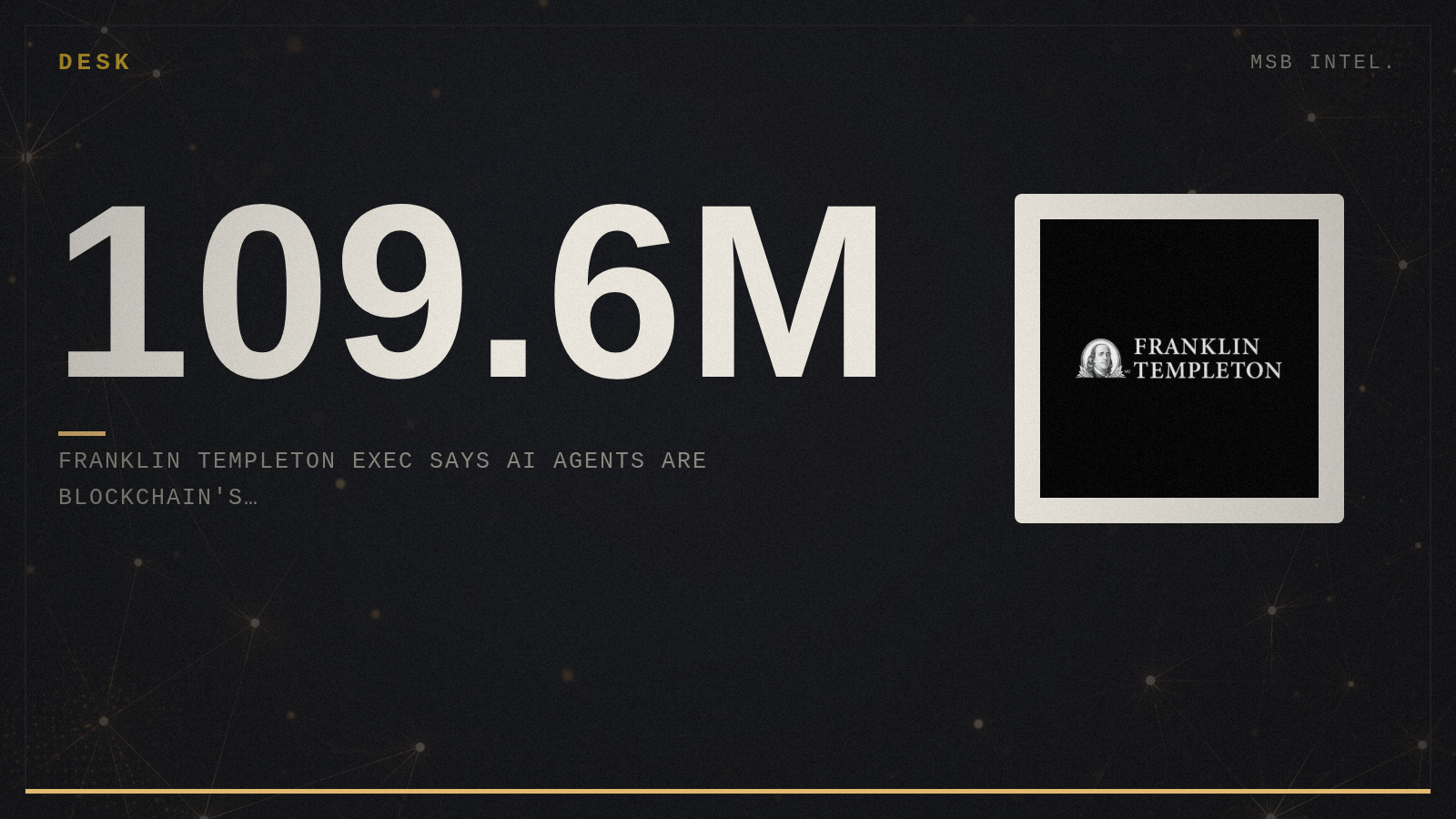
Sandy Kaul, head of digital assets and innovation at Franklin Templeton, argues that autonomous AI agents require settlement speeds incompatible with traditional card networks that operate on one- to three-day cycles.
Kaul contends that machines paying each other in seconds at near-zero cost demand blockchains purpose-built for the task. He points to Solana, Aptos, and BNB Chain as networks already structured for agentic transactions. The early adoption data shows a pattern of extreme volume at minimal value: the x402 protocol has processed 109.6 million transactions worth a combined $15 million since launching in May 2025, according to a Visa and Artemis report released in July 2026.
The x402 protocol emerged as a standardized format for machine-to-machine payments on blockchain networks. Its transaction count represents roughly 4,000 times the typical daily volume of centralized exchanges, compressed into fourteen months. The median transaction size works to approximately $0.14 per transfer, a scale incompatible with credit card infrastructure that charges fixed or percentage-based fees.
Franklin Templeton has positioned itself at the intersection of traditional asset management and digital-native infrastructure. The firm launched a blockchain-based money market fund in 2023 and has since expanded into tokenized Treasury products and digital asset custody. Kaul's statement acknowledges autonomous systems as a primary use case rather than a speculative vertical.

The Visa-Artemis analysis frames agentic transactions as distinct from human-initiated crypto trading or payments. The category includes smart contract executions, liquidation cascades, arbitrage flows, and coordinated oracle updates, activity where speed and cost matter more than transaction finality.
Solana processes approximately 400,000 transactions per second at theoretical capacity. Aptos and BNB Chain operate at lower confirmed throughput but still target sub-second finality. Traditional payment networks settle at batch intervals; x402's design allows for atomic clearing on every block.
Kaul positions AI agents as blockchain's killer use case, departing from the industry's historical framing of cryptocurrency as peer-to-peer electronic cash for humans. If agentic transaction volume continues its current arc, the economic justification for blockchain infrastructure shifts from retail adoption to machine-native settlement.