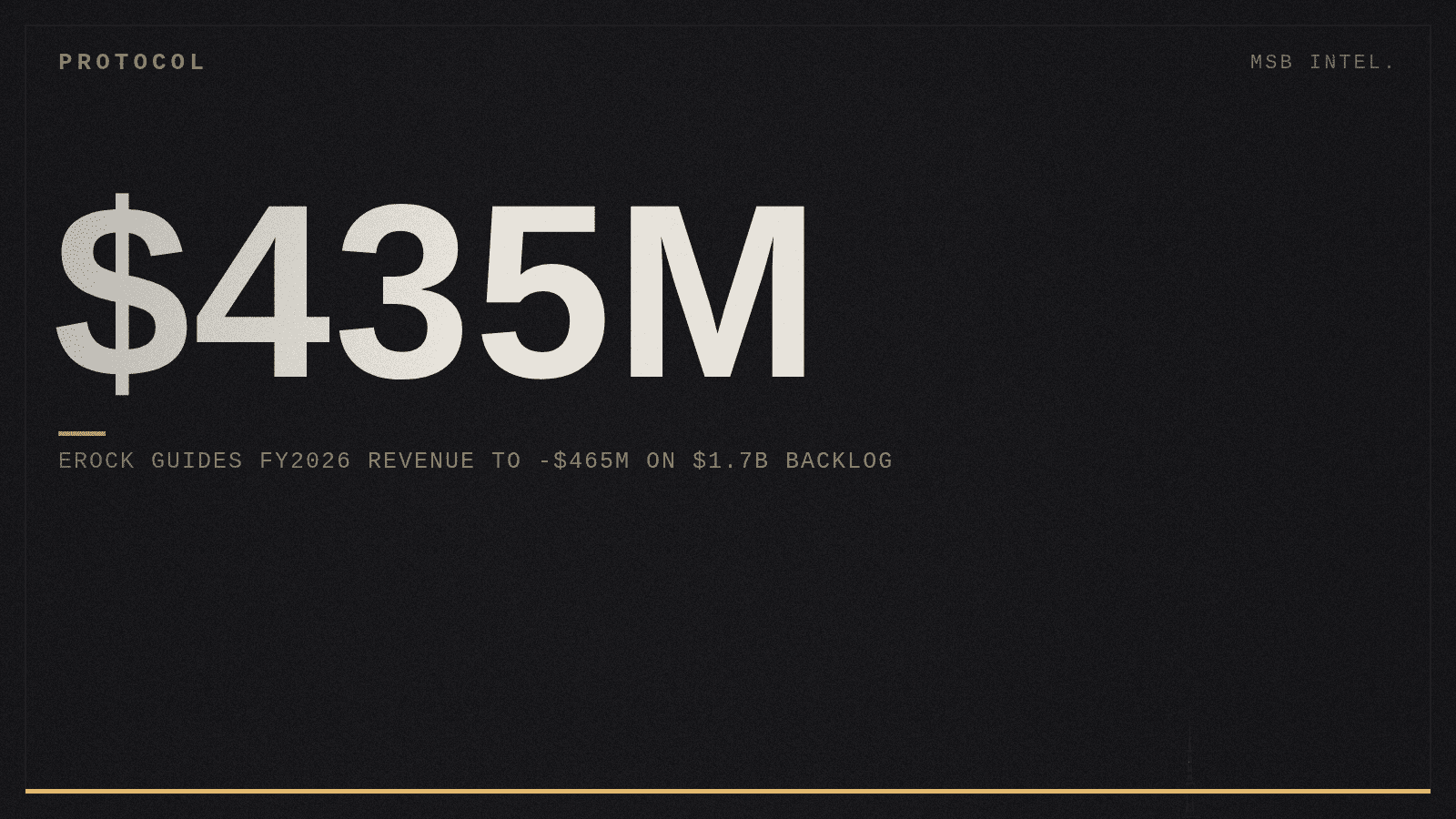
ERock, an onsite power solutions provider, projected FY2026 revenue between $435 million and $465 million alongside adjusted EBITDA of $3 million to $9 million, according to the company's Q2 2026 earnings announcement. The backlog reached $1.7 billion.
The guidance anchors revenue visibility for the fiscal year ahead. A backlog at that scale typically covers 12 to 18 months of production capacity for industrial equipment manufacturers.
ERock's adjusted EBITDA range of $3 million to $9 million spans a 200 percent swing at the high end relative to the low end, typical for a guidance band issued three to six months before year-end when certain contracts or delivery schedules remain subject to negotiation or customer call-off timing. The midpoint of the revenue range, $450 million, would represent growth from prior-year performance if the prior-year baseline is below that figure.
The company serves data center operators facing power demand constraints as artificial intelligence workload growth accelerates. Data center operators have increased capital allocation toward on-site generation to secure reliable power supplies independent of grid capacity. ERock's backlog expanded from prior periods.

A $1.7 billion backlog paired with a $450 million revenue midpoint implies a conversion ratio of approximately 0.26, meaning the company expects to book and complete about 26 percent of its backlog within the next fiscal year. The remainder rolls into future periods or contingent customer commitment structures.
ERock's margin guidance places adjusted EBITDA near the low end. A $3 million EBITDA floor against a $435 million revenue floor yields a 0.69 percent EBITDA margin; a $9 million ceiling against a $465 million ceiling yields 1.94 percent. For industrial equipment manufacturers, such thin margins typically accompany competitive pricing in a supply-constrained market or initial ramp-up costs on new manufacturing capacity.
The backlog announcement occurred within 48 hours of this filing. Whether ERock can sustain backlog growth or convert the current book into higher-margin revenue in subsequent years depends on demand from data center operators and the company's ability to expand production throughput without diluting margins further.