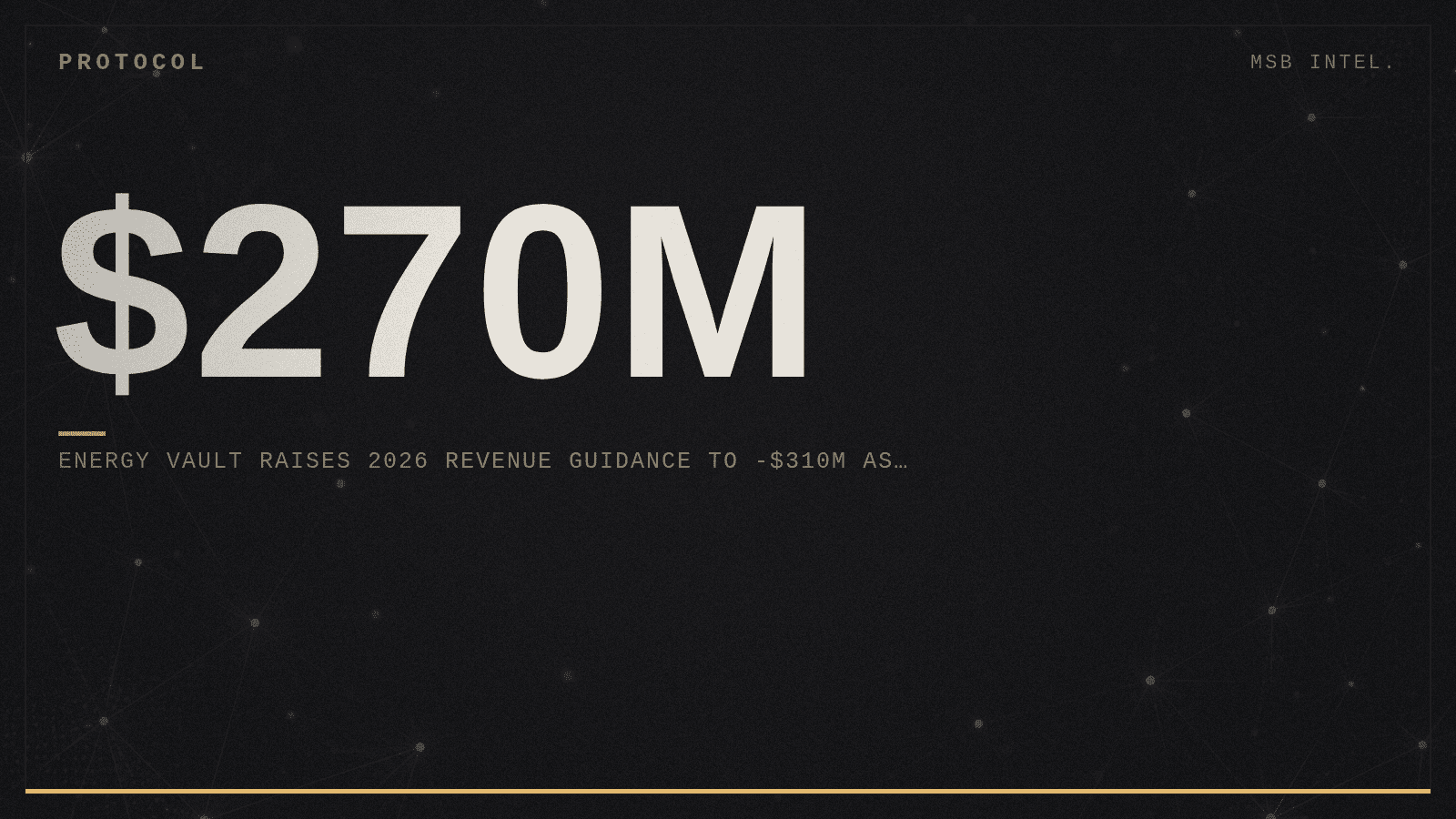
Energy Vault raised its 2026 revenue outlook to $270 million to $310 million, up from prior guidance of $225 million to $300 million, as the energy storage company's backlog approached $2 billion.
The backlog reached roughly $2 billion as of August 10, according to the company's Form 8-K filing with the SEC, representing 107 percent year-over-year growth. Energy Vault designs gravity-based energy storage systems that lift and lower weights to store and discharge electrical power, a mechanism distinct from battery and pumped-hydro competitors.
The revised guidance follows stronger-than-expected contract execution in the first half of 2026. Energy Vault reported $560 million in total backlog at the end of 2025, meaning the company has roughly tripled its pipeline in eight months. The new backlog figure includes signed contracts and letters of intent from utility, industrial and renewable energy customers across North America and Europe.
Gravity storage has attracted capital from institutional investors betting that mechanical systems can undercut lithium-ion battery costs for long-duration discharge cycles, typically four hours or longer. Energy Vault competes directly with Form Energy, which raised $260 million in Series C funding in 2023, and EnerTech Capital-backed Hydropower, which is developing compressed-air storage. Traditional battery makers including Tesla and Fluence have also entered the long-duration segment.

Energy Vault trades on the Nasdaq under ticker NRGV after merging with a special purpose acquisition company in 2021. The 2026 revenue midpoint of $290 million would represent roughly 400 percent year-over-year growth from the company's 2025 full-year revenue of approximately $67 million.
The backlog surge coincides with a broader shift in U.S. energy procurement driven by data center construction and state renewable mandates. Energy Vault secured contracts with Meta Platforms and other major technology firms for data center power needs. Execution on the backlog at historical gross margins and closure at the high end of guidance would position the company toward cash-flow breakeven by late 2026 or early 2027.
The metric to watch is Energy Vault's third-quarter backlog figure, due in November, which will show whether the $2 billion milestone holds or accelerates further before year-end contract awards.