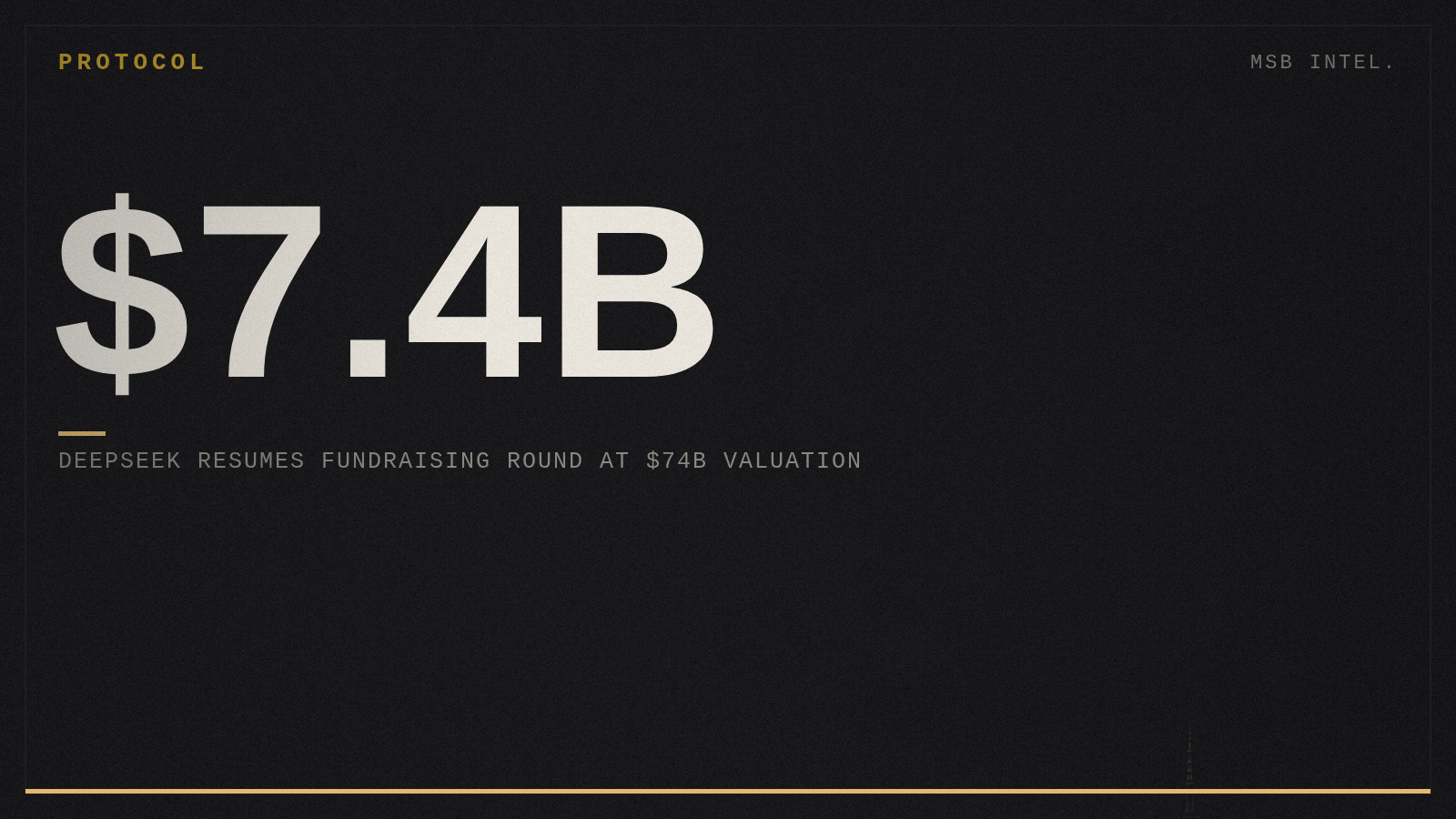
DeepSeek has restarted its second fundraising round after a late-July suspension, seeking $7.4 billion at a $74 billion pre-money valuation, according to reports on the financing talks.
The Chinese AI company's decision to resume the raise marks a reversal from the hiatus it imposed last month. The restart timing coincides with a period of intensifying competition in frontier AI development, where funding rounds at nine-figure valuations have become routine among well-capitalized builders.
DeepSeek emerged into public attention in 2024 as a low-cost alternative to OpenAI's reasoning models, gaining adoption among developers and enterprises seeking cost efficiency. The company operates R1, an open-source reasoning model, and has positioned itself as a research-focused competitor in an market where training costs and inference speeds determine competitive advantage.
A $7.4 billion raise at $74 billion pre-money would value DeepSeek at roughly $81.4 billion post-money, assuming standard dilution mechanics. That valuation sits below OpenAI's $200 billion internal price in secondary markets but exceeds funding targets set by most other reasoning-model developers in the same window.

The company suspended its fundraising in late July without announcing a reason. DeepSeek is backed by High-Flyer, a Chinese tech investment firm, and has drawn interest from global allocators betting on alternative architectures to U.S.-trained large language models.
The funding environment for AI builders has remained active despite macroeconomic volatility. Series B and later rounds for reasoning-model companies have closed at valuations ranging from $20 billion to $100 billion across 2025 and 2026, though the pace of announced closings has slowed from its 2024 peak.
DeepSeek's restart at $74 billion pre-money positions it among the highest-valued reasoning-model companies outside OpenAI and Anthropic by stated round metrics, though valuations in secondary markets often diverge from announced fundraising prices. The filing or announcement of lead investors in this round would clarify appetite among tier-one firms for Chinese-based AI infrastructure plays at scale.