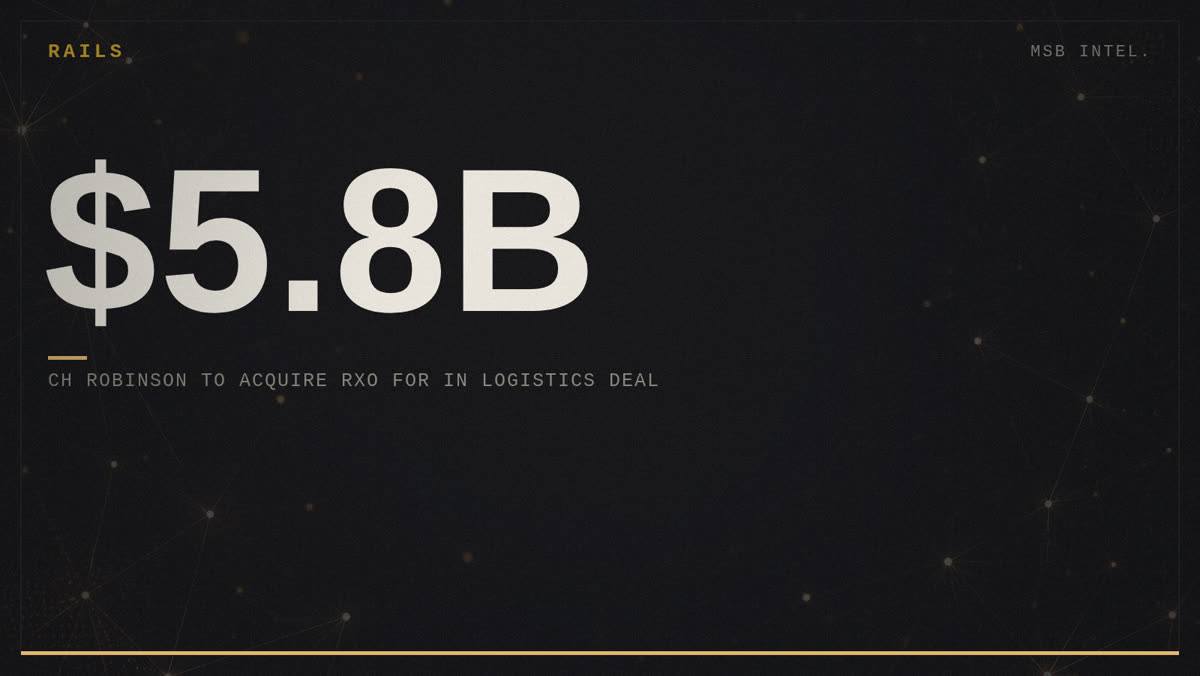
CH Robinson Worldwide agreed to acquire trucking brokerage RXO in a $5.8 billion stock-and-cash transaction, betting that artificial intelligence can drive cost reductions in freight brokerage operations. The deal targets $300 million in annual cost savings, according to the announcement.
The acquisition combines two major players in freight intermediation at a time when logistics carriers face pressure from weak demand and thin margins. RXO, spun out from XPO Logistics in 2023, has built a platform that moves roughly 1.6 million shipments annually. CH Robinson, already the largest freight broker in North America by revenue, is betting that AI-powered load matching and routing can improve how many loads each truck carries and reduce the manual labor required to coordinate shipments between shippers and carriers.
CH Robinson's board approved the all-stock transaction with a cash component, the company said in a filing. The deal is expected to close in the second half of 2027, subject to regulatory approval and customary closing conditions. Neither company disclosed financing arrangements.
Freight brokerage is fundamentally an information arbitrage: brokers match shippers who need to move goods with carriers who have empty truck capacity. The industry operates on thin margins, typically 5 to 8 percent, and depends on speed and accuracy in pairing loads with equipment. AI tools that can predict shipper demand patterns and recommend optimal routing in real time could compress the human time required to execute each transaction.
The $5.8 billion valuation represents roughly 2.2 times RXO's trailing twelve-month revenue of $2.6 billion based on the company's most recent public filings. The multiple sits above historical precedent for broker acquisitions, which typically trade at 1.5 to 1.8 times revenue, though integration cost reductions and AI efficiency gains may justify the premium in CH Robinson's analysis.
RXO shares have traded under pressure since its spinoff. The freight market entered a sustained downturn in 2024 after five years of above-trend demand from pandemic-era supply chain disruptions. The National Freight Transportation Forecast expects ton-miles of freight to remain flat through 2027, creating incentive for brokers to compete on automation and cost rather than volume.
CH Robinson's $300 million cost reduction target breaks down into two categories: technology integration and operational consolidation. The company expects to retire duplicate platform systems and consolidate back-office functions across accounting, human resources, and sales support. The second component is harder to quantify without full integration plans; the company has not disclosed what portion of the $300 million target comes from AI-driven improvements versus simple head-count reductions.
If CH Robinson achieves the full $300 million annual run-rate savings, the deal payback period would be roughly 19 years on the combined transaction value, a timeline that depends entirely on the company's ability to implement promised integration without customer churn. Customer retention in brokerage acquisitions is not automatic; RXO and CH Robinson serve overlapping shipper and carrier bases, and defections during transition could narrow the realized benefit.
The number to watch is CH Robinson's customer retention rate in the first two quarters after close. If RXO loses more than 10 percent of its shipper accounts during integration, the $300 million savings target becomes mathematically unachievable.