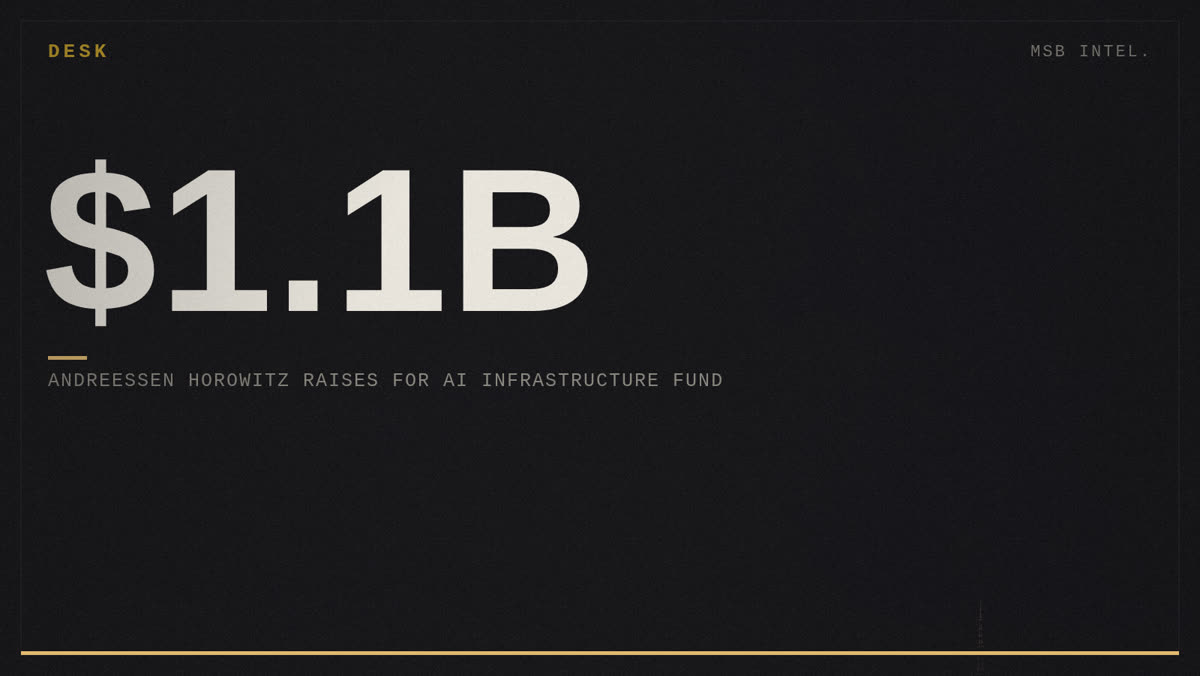
Andreessen Horowitz has closed a $1.1 billion fund dedicated to physical AI infrastructure, the firm announced. The Machine Age fund will invest in hardware including chips, memory systems, data centers and robotics rather than software or model training.
The fund size matches the scale of a16z's recent crypto infrastructure plays. In 2022, the firm raised $4.5 billion across two crypto funds after a period of rapid deployment into blockchain and web3 companies. The new AI infrastructure vehicle targets hardware and physical systems as compute demand intensifies and model capabilities plateau.
Andreessen Horowitz has been active in AI infrastructure deals over the past 18 months. The firm backed CoreWeave, a GPU cloud provider, and has invested in semiconductor and data center companies. The Machine Age fund formalizes this activity into a dedicated strategy.
The fund closes as venture capital firms compete for allocation into AI infrastructure. Other large VCs including Sequoia, Benchmark and Khosla Ventures have also launched or expanded infrastructure-focused funds. The sector has attracted institutional capital from pension funds and sovereign wealth funds seeking exposure to the physical buildout underpinning AI model deployment.
Andreessen Horowitz manages roughly $40 billion in assets under management across its venture and growth funds. The $1.1 billion Machine Age fund represents 2.75% of that total, a smaller allocation than the firm's crypto infrastructure funds but targeted at a narrower set of hardware opportunities.
The firm's focus on physical assets rather than software assumes that computational limits will become the constraint on model scaling. Capital deployment into data centers, chip fabrication, and memory infrastructure may outpace investment in software platforms or AI applications. The fund's mandate covers both the silicon layer and the robotics applications that consume compute at the edge.
A16z will need to deploy the capital into companies with material revenue or clear paths to profitability, a higher bar than the firm faced during earlier venture phases. The infrastructure stack for AI differs from cloud computing in requiring bespoke hardware and long development cycles, limiting the number of viable acquisition or IPO exits.