
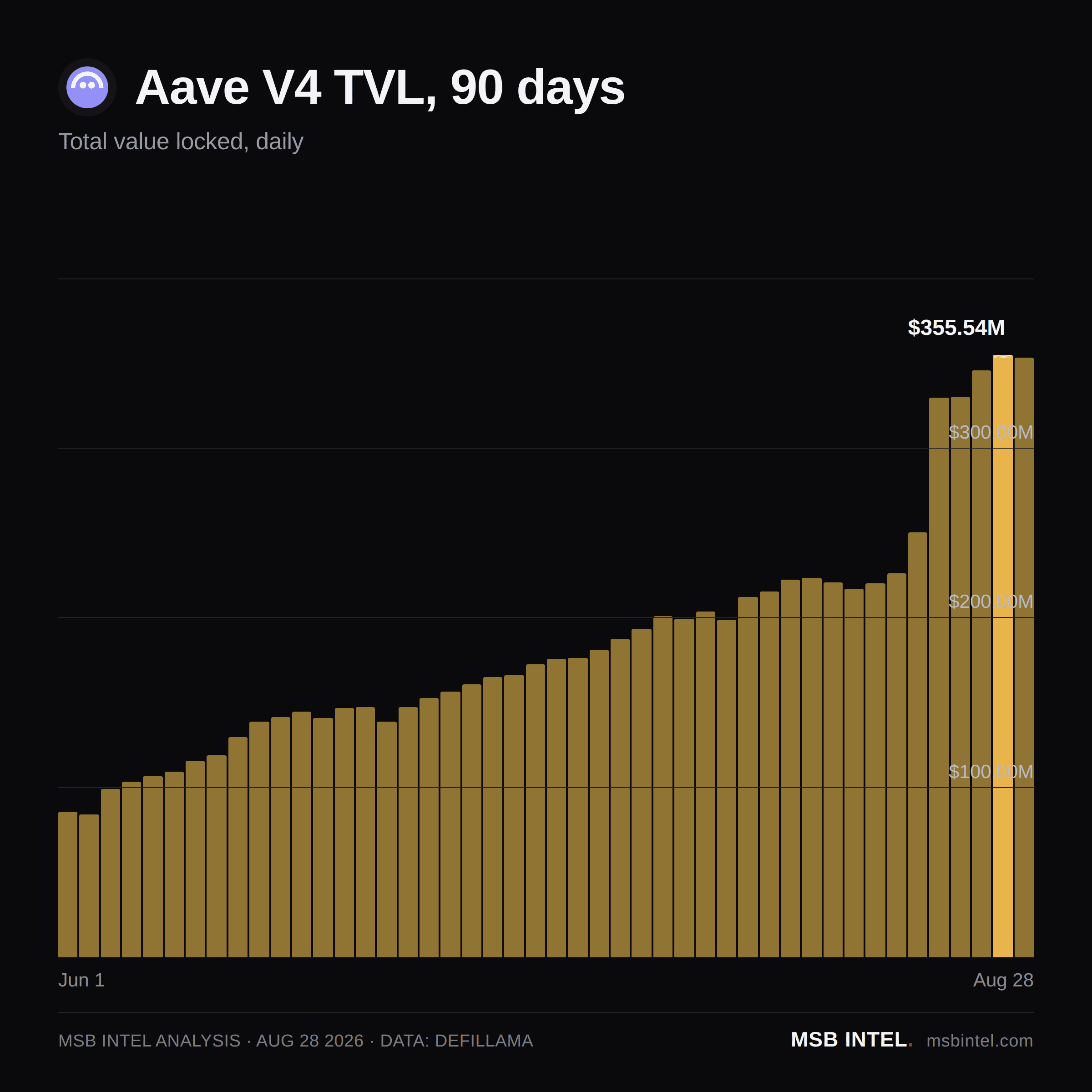
Aave V4 deposits reached $806 million, according to on-chain data, marking an all-time high after climbing 30 percent over the past week as the protocol extended a sharp growth trend through August.
The deposit surge accelerated after the protocol crossed $500 million on August 19, followed by a $600 million milestone two days later. The velocity of those milestones, $100 million in two days, then $206 million more within a week, shows capital inflow has not plateaued.
Ethereum Core holds the largest position in V4 deposits, while EtherFi Cash accounts for $257 million of the total, representing roughly one-third of all capital deployed to the version. The protocol also supports $216 million in active loans across its markets, with borrowing activity moving alongside deposit growth rather than lagging it.
Aave V4 launched as an upgrade to the core lending protocol designed to improve capital efficiency and reduce liquidation risk through a new risk management framework. The version introduced isolated markets, allowing users to deposit collateral specific to individual asset pairs rather than pooling all deposits into a single shared reserve. That architecture has been adopted in parallel instances across multiple blockchains.
The August deposit acceleration extends a longer pattern of growth for Aave. Total value locked across all Aave versions exceeded $10 billion in mid-August, with V4 capturing a growing share as new market deployments matured. The protocol's governance token, AAVE, traded around $135 on August 27, off roughly 12 percent from its 2026 high.
Aave V4's deposit base has grown from under $200 million in early August to $806 million in roughly three weeks, a 4x expansion. The weekly 30 percent gain is more than double the typical growth rate for established lending protocols in stable market conditions, with capital allocation shifting toward V4 rather than spreading evenly across competing platforms.
The number to watch is whether V4 sustains weekly deposit inflows above $100 million through September, which would confirm the August surge was driven by genuine user demand rather than a one-time event tied to a governance decision or incentive program.